
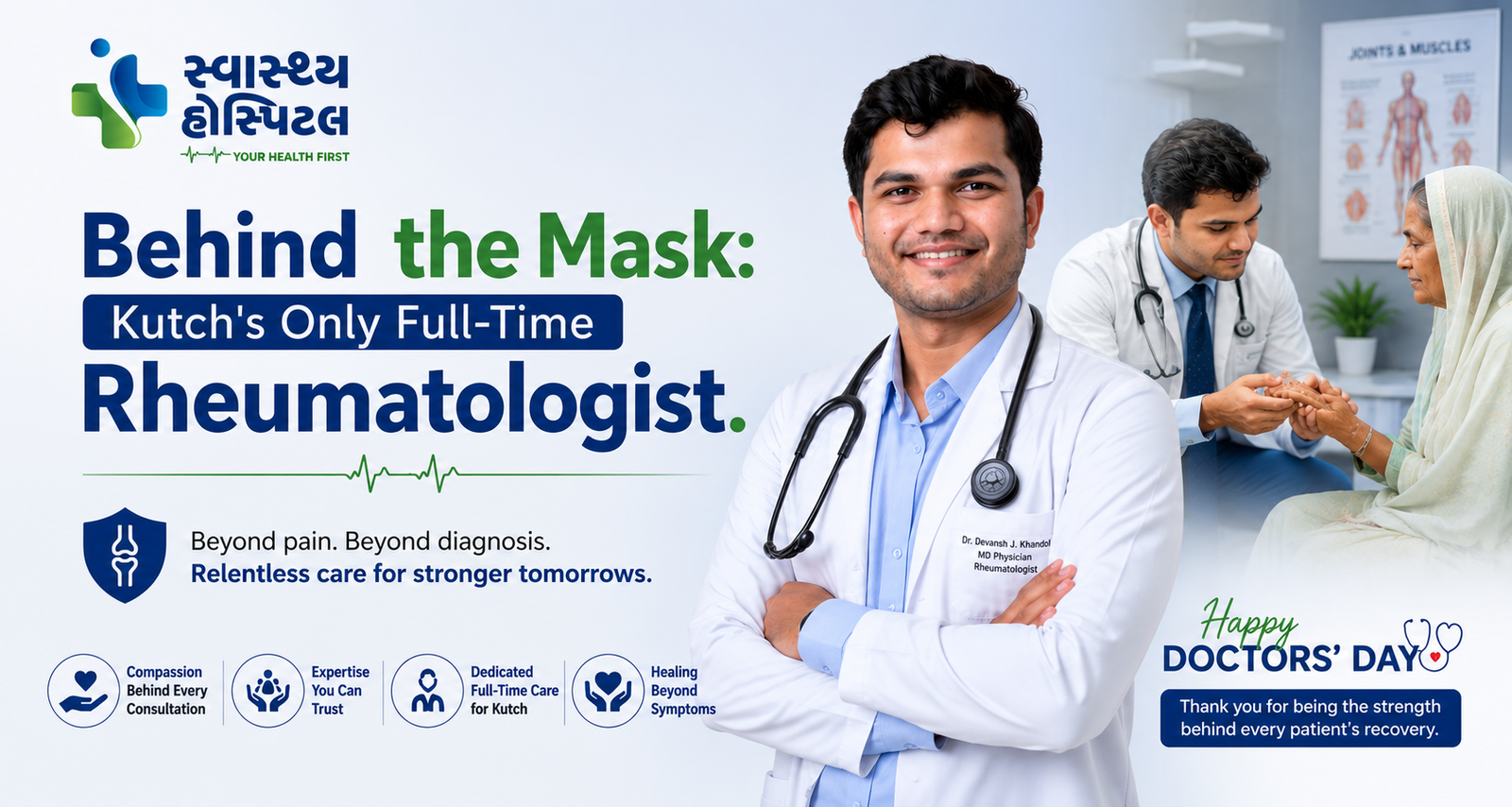
Behind the Mask: I'm Kutch's Only Full-Time Rheumatologist
Every white coat hides something. This Doctor's Day, I take mine off for a moment to share what's behind thirteen months as Kutch's only full-time rheumatologist - the patient who taught me what this job is for.
Why I Put This Mask On
I chose rheumatology because Kutch needed someone to. There are so many patients here with autoimmune disease and, until recently, no full-time specialist for them. I first felt the pull toward this field during my residency at Dr. D.Y. Patil Hospital, Pune, where the complexity of these cases got under my skin in a way nothing else had. Later, I trained under Dr. Sapan Pandya, a widely regarded figure in the field of rheumatology (also Gujarat's first rheumatologist), and that's when I knew this was mine to do.
When I finally give a patient a diagnosis they've been chasing for years, something in me settles. That's the part of the mask that doesn't feel like a mask at all.
What's Actually Underneath It
My mornings start with rounds, where I counsel admitted patients on what's next. I play bad cop and good cop, whichever the moment needs, because some patients need hope and some need a warning. Then OPD opens, and every patient walks in with a new story. I've learned that listening does half the healing; the other half is convincing someone why they should let a foreign object - the medicine - into their body in the first place.
What people don't see is that I study every single day. Doctors joke that you study until the day you die, but I actually live by it, because evidence-based medicine only works if I keep it current. The hardest moment is the 3 a.m. call. My body wants to handle it over the phone and go back to sleep. But I know what it feels like to be a patient with no idea what's happening to your body and no doctor to ask. So I get up, because the relief on someone's face the next morning is worth the night I lost.
The Patient Who Took the Mask Off Me
A 33-year-old vegetable vendor, his family's only earner, had been bedridden for six months before he came to me in an emergency, on oxygen support. The first two days showed almost no visible improvement, and his relatives, who couldn't afford to keep going, started talking about stopping. I asked them to hold on. Five days later, he turned a corner.
It's been nine months. He hasn't missed a single follow-up. He's back at work, back to being the person his family depends on. When I think about him, I don't see a case file - I see proof that with the right guidance, people don't have to fall into the loop of poverty and untreated illness. That patient is the reason the mask is worth wearing.
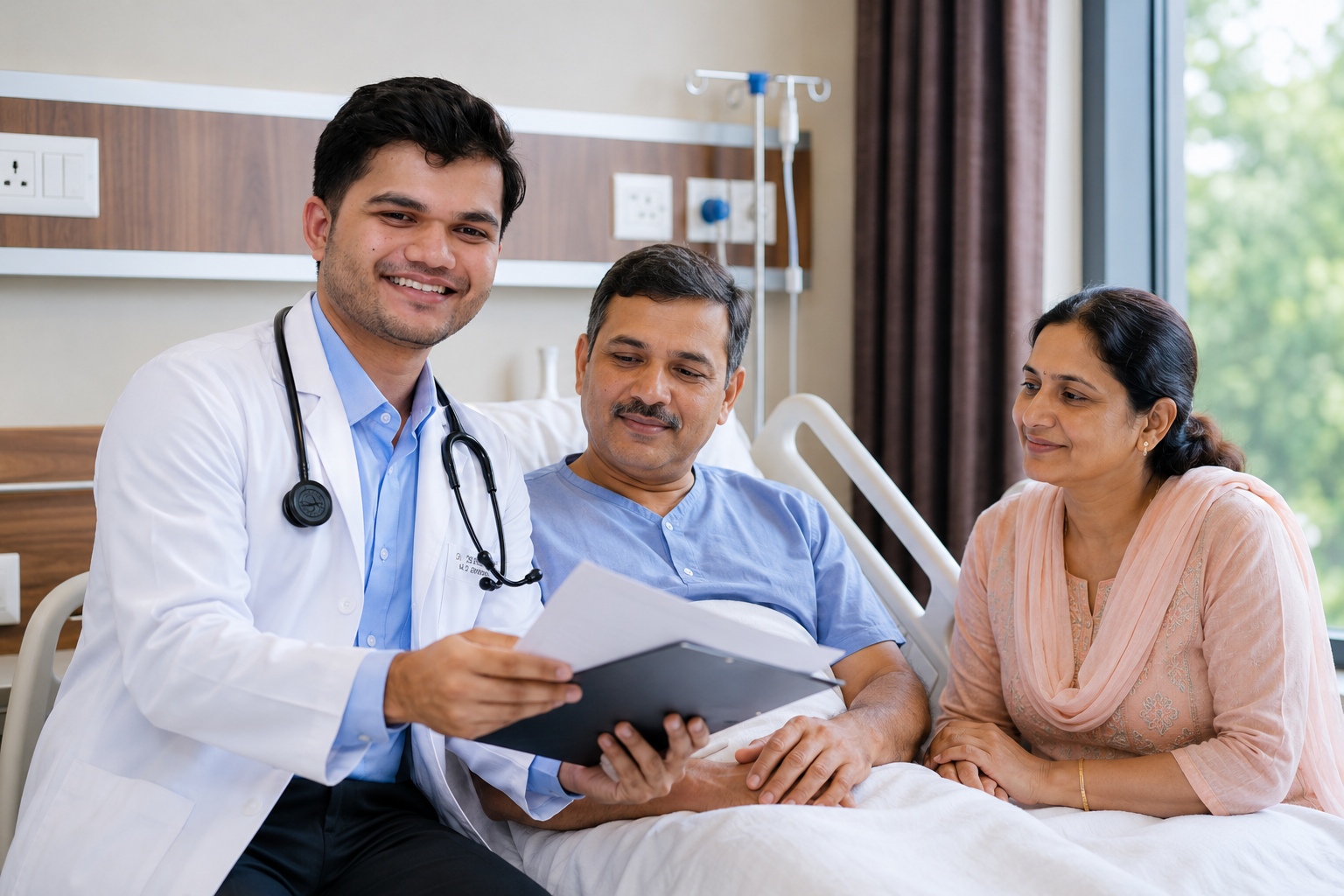
Who Heals Me When I Take It Off
Here's the part most people never ask about. A hospital is one of the most negative places anyone walks into, full of other people's pain and fear. I've had to learn to be the thing that absorbs all of that and still hands back something positive. I've also had patients I couldn't save, and patients who stopped treatment no matter how much I explained, and both used to wear me down more than I let on. What got me through was deciding to count what was going right, on purpose, for my own sake as much as theirs.
During my residency, 72-hour duties tested every part of me. My family couldn't tell me what to do clinically, since I'm the first doctor in my family, but they kept me standing anyway, and that mattered more. I rest differently now too. We're trained early to be ready at any hour, so when I finally do get to switch off, I switch off completely. My real self-care isn't a routine anyone would put in a brochure. It's other doctors and me, comparing notes on a hard day and laughing about it, just enough to put it down before picking it back up tomorrow.
What I Wish You Could See Through the Mask
The mix-up I hear most often is patients confusing what I do with orthopedics, because both specialties can show up as joint pain.
| Aspect | Orthopedician | Rheumatologist (what I do) |
|---|---|---|
| Focus | Bones, joints, structural injury | Autoimmune and inflammatory disease |
| Typical approach | Surgery, joint replacement, mechanical relief | Long-term management of systemic disease |
| Organs affected | Mostly the joint itself | Can include liver, kidney, and heart |
| When it shows up | Usually after injury or wear | Often with no injury, alongside fatigue or other symptoms |
If your joint pain has no injury behind it - especially if it comes with fatigue or symptoms that don't add up - please don't wait it out. Untreated rheumatic disease isn't just pain. Left alone, it can cost you an organ, not just a joint. I'd rather see you early and be wrong than see you late and be right.
Before I Put the Mask Back On
If anything here sounds like you or someone you love, I'd genuinely like to see you for a rheumatology consultation. And if it's not rheumatology you need, my colleagues at Swasthya Hospital and I work as one team across cardiology, gastroenterology, neurology, nephrology, endocrinology, pulmonology, hematology, and infectious disease care, all under one roof in Gandhidham.
You can reach us through the About Us page. The mask goes back on tomorrow morning either way. I'd just like it to be for you.
- Dr. Devansh J. Khandol, MD Physician and Consultant Rheumatologist, Swasthya Hospital
Living with unexplained joint pain, fatigue, or symptoms that don't add up? Book a rheumatology consultation with Dr. Devansh J. Khandol at Swasthya Hospital, Gandhidham.
Book a Consultation