
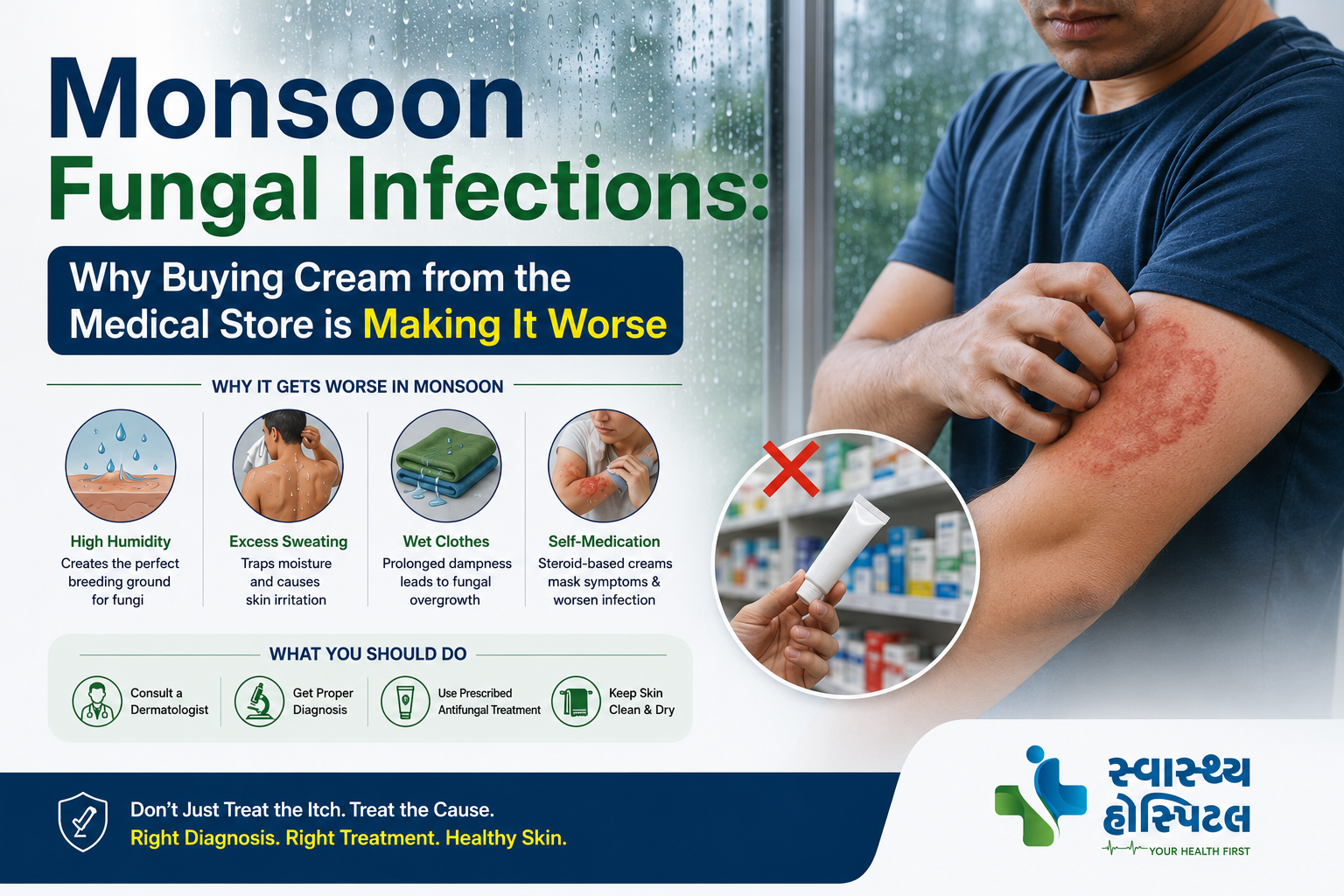
Monsoon Fungal Infections: Why Buying Cream from the Medical Store is Making It Worse
Steroid combination creams bought over the counter are turning ordinary monsoon fungal infections into harder, longer-lasting cases — here's why that "quick fix" tube is the worst thing reaching for it first.

Monsoon humidity creates the warm, damp conditions dermatophyte fungi need to spread on skin.
The fungal infection India sees every monsoon follows a simple rule: warmth plus moisture equals fungal growth, and Gandhidham's monsoon humidity, regularly sitting between 70 and 90 percent, builds exactly that environment on skin that stays damp for hours at a stretch. Dermatophytes, the fungi behind ringworm and tinea, treat that combination as an open invitation.
Five Fungal Infections Monsoon Brings, and How to Tell Them Apart
Several distinct infections show up under this one umbrella, and telling them apart matters for treatment. Tinea cruris, known as crotch itch, is most common in men who drive or sit for long hours in sweat-soaked clothing. Tinea pedis, or athlete's foot, develops between the toes in anyone wearing wet or closed shoes all day. Tinea corporis, daad or ringworm, spreads as circular, scaly rings on the body and passes easily through shared towels or clothing. Tinea versicolor causes patchy discoloration on the chest and back, driven by Malassezia yeast rather than a dermatophyte, and also worsens in humidity. Intertrigo develops under the breasts, in the armpits, and in skin folds, where friction, moisture, and a fungal or bacterial co-infection combine.
| Infection | Common Name | Where It Appears | Cause |
|---|---|---|---|
| Tinea cruris | Crotch itch | Groin, inner thighs | Dermatophyte fungus |
| Tinea pedis | Athlete's foot | Between the toes | Dermatophyte fungus |
| Tinea corporis | Daad / Ringworm | Body, in circular rings | Dermatophyte fungus |
| Tinea versicolor | Patchy discoloration | Chest, back | Malassezia yeast |
| Intertrigo | Skin-fold rash | Under breasts, armpits, skin folds | Friction + fungal/bacterial co-infection |
The Steroid Cream Disaster
The most damaging pattern doctors see every monsoon, when fungal infections spike across India, is not the fungus itself — it is what people apply to it first. Several OTC combination creams sold in Indian pharmacies, including well-known brand names, combine a corticosteroid with an antifungal in one tube, formulated for eczema, not for tinea. Applied to a fungal patch, the steroid suppresses the local immune response, and the itching eases within days. The relief feels like a cure. Underneath it, the fungus is spreading faster, undisturbed by an immune system that has been told to stand down, often leaving a pale, deceptively clear centre — a pattern doctors call tinea incognito.
The infection seems to fade for 5 to 7 days, then returns larger, more widespread, and considerably harder to treat than it would have been at the start. What began as a patch that a two-week topical antifungal could have cleared now often needs oral itraconazole or fluconazole instead. Clinicians have a name for this now: steroid-modified tinea, a pattern that has become common enough in India to be described as a growing epidemic of OTC steroid cream misuse.

Steroid-antifungal combination creams ease itching short-term but let the underlying fungal infection spread.
Red flag reminder: if a fungal patch faded after a steroid combination cream and then came back larger, that is steroid-modified tinea — not a relapse to self-treat again.
The Correct Treatment Pathway
The correct treatment pathway is straightforward once a doctor confirms the diagnosis. Confirmed tinea calls for a topical antifungal alone, never a steroid combination. Extensive or recurrent cases need oral itraconazole or an equivalent antifungal on top of the topical treatment. Either way, treatment needs to continue for at least 2 weeks after the skin has fully cleared, since stopping early is one of the most common reasons a fungal infection that patients thought was gone comes straight back.
Hygiene Habits That Actually Work
A handful of hygiene habits make a real difference in monsoon. Change inner clothing twice a day and wash it in warm water rather than leaving sweat-soaked fabric on for hours. Keep one separate, dry towel for an affected area and wash all towels every 2 days. Dry between the toes and inside skin folds after every bath, using a hairdryer on a cool setting if a towel alone does not get the job done. Antifungal dusting powder containing clotrimazole, used preventively on high-risk areas through the season, keeps skin drier than it would otherwise stay. None of this works if towels, underclothing, or razors get shared, which is also how tinea corporis spreads between family members in the first place.
When to See a Doctor
See a doctor if a patch keeps spreading despite 2 full weeks of correct OTC antifungal use, if it reaches the scalp or nails, or if the patient is diabetic, since fungal infections in patients managed for diabetes through endocrinology care tend to go deeper and resist treatment longer than they would in someone with normal blood sugar control. The same caution applies to patients on long-term immunosuppressive treatment for chronic conditions managed through rheumatology care, since a suppressed immune response can let a fungal infection spread further before it's noticed. A fungal infection in India that keeps coming back every monsoon season is rarely an emergency, but it is also not something to keep self-treating once a steroid-combination cream has already been tried.
Get It Treated Properly
Swasthya Hospital's skin and fungal infection OPD in Gandhidham is built for exactly the fungal infection pattern monsoon keeps repeating across India, evaluating tinea, ringworm, and steroid-modified cases that have outgrown OTC treatment, and starting the antifungal course that actually clears them. Stop the spread before it spreads further.
Stop self-treating with the wrong cream — get a confirmed diagnosis and the right antifungal course.
Get Skin & Fungal Infection OPD Care in Gandhidham