
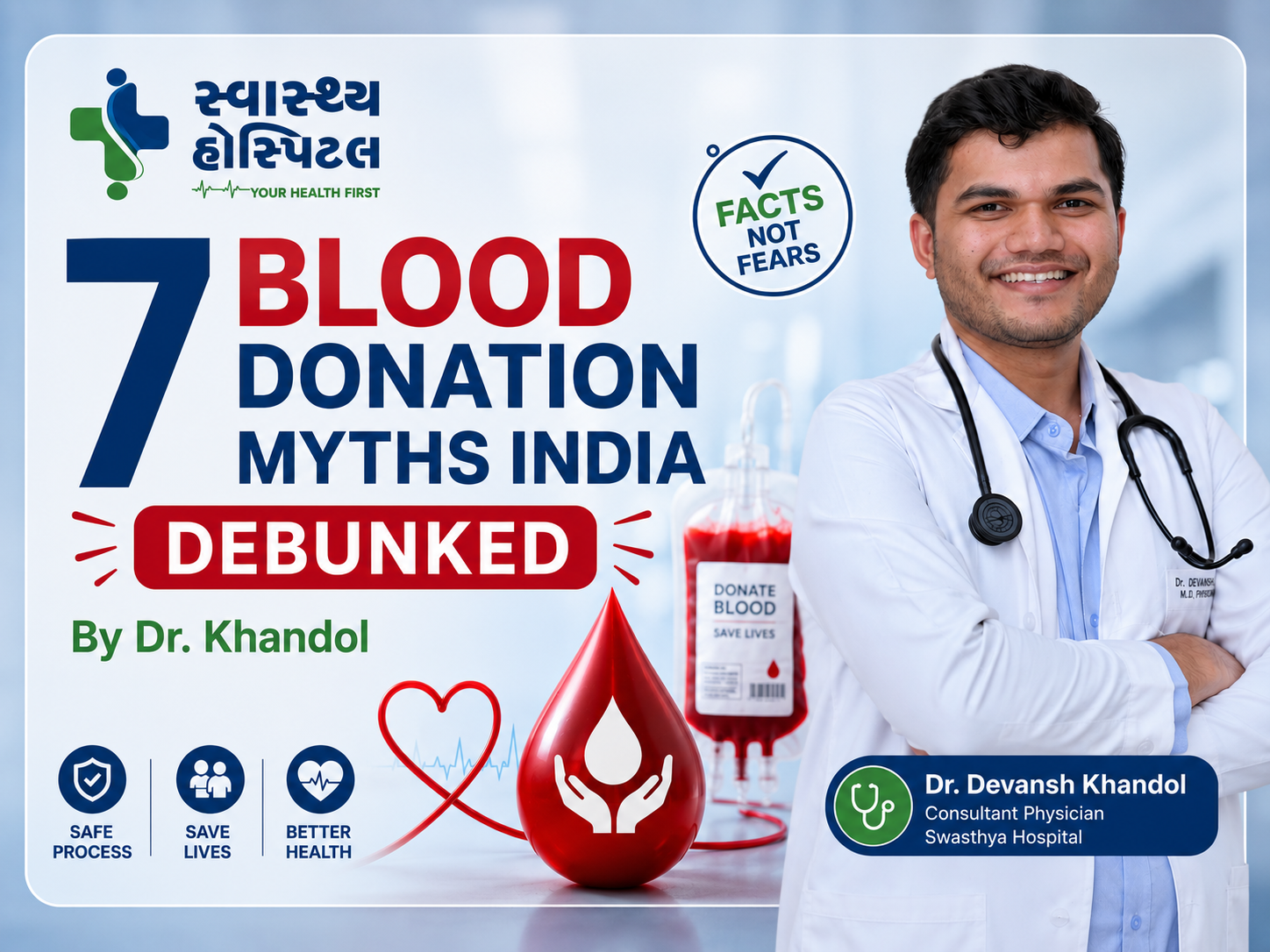
7 Blood Donation Myths Every Indian Believes - Debunked by Dr. Devansh Khandol
Only about 7.5% of India's eligible adults donate blood, even though demand far outstrips supply. The reason is rarely apathy - it's the blood donation myths India keeps repeating as settled fact.

Awareness drives remain the most effective way to close India's blood donation gap.
Every World Blood Donor Day, the same statistic repeats: only about 7.5 percent of India's eligible adults actually donate blood, even though most blood banks could use far more. Doctors who track this gap point to the same root cause again and again. It is rarely apathy. It is the blood donation myths India keeps repeating to itself, passed between families and friend groups as settled fact.
The Blood Donation Myths India Still Believes
Dr. Devansh Khandol, Consultant Physician and Rheumatologist at Swasthya Hospital, hears these blood donation myths from patients and healthy donors alike, and addresses the seven that come up most often.
Myth 1 - Blood donation causes weakness
The truth is the opposite of what most people expect. Plasma volume is restored within 24 hours, and red blood cells return to normal within 4 to 6 weeks, while bone marrow ramps up production almost immediately after donation. For a healthy adult who meets the screening criteria, there is no measurable weakness afterward. Many people still search online asking whether blood donate karne se kamzori hoti hai - and the honest clinical answer is no.
Myth 2 - People with tattoos can never donate blood
In India, a tattoo done at a licensed, sterile facility clears for donation once it is at least 6 months old. An unlicensed tattoo extends that wait to 12 months. Either way, it is a temporary deferral, not a lifetime ban, and the blood bank will confirm the exact timeline at screening.
Myth 3 - Diabetics cannot donate blood
Controlled diabetics managing their condition on oral medication, who meet every other screening criterion, are generally eligible. Insulin-dependent diabetics are usually deferred, though the exact rule can vary slightly by blood bank protocol, so it is worth asking directly rather than assuming.
Myth 4 - Donating once means you are committed to donating again
There is no such obligation anywhere in the process. Each donation is entirely voluntary, and skipping the next blood donation drive carries no consequence at all.
Myth 5 - Blood donation is painful
In practice it is one needle prick, comparable to a routine blood test, with discomfort lasting roughly 3 to 5 seconds. The donation itself, once the needle is placed, is not painful.
Myth 6 - Medication rules a person out automatically
Most common medications - anti-hypertensives, thyroid medication, antihistamines - are compatible with donating. Aspirin is the main exception, requiring a 48-hour wait beforehand. The safest approach is to disclose every medication during screening and let the blood bank team make the call.
Myth 7 - My blood type is too common to matter
O positive is the most common type in India, which is exactly why it is also the most transfused. Hospitals draw on it constantly, and every blood type, common or rare, gets used. Of all the blood donation myths on this list, this one costs the blood bank the most willing donors for the least reason.
| Myth | Clinical Reality |
|---|---|
| Causes weakness | No measurable weakness in healthy donors; plasma restores in 24 hrs, red cells in 4-6 weeks |
| Tattoos = permanent ban | Temporary deferral only - 6 months (licensed) or 12 months (unlicensed) |
| Diabetics can't donate | Controlled, oral-medication diabetics are generally eligible |
| One donation = ongoing commitment | Fully voluntary every time; no obligation to return |
| It's painful | One needle prick, 3-5 seconds of discomfort, comparable to a blood test |
| Medication disqualifies you | Most medicines are fine; only aspirin needs a 48-hour wait |
| Common blood type doesn't matter | O positive is most common and most transfused - always needed |
Who Genuinely Cannot Donate Right Now
Clearing up blood donation myths is only half the picture. The real eligibility rules still apply, and they exist for the donor's safety as much as the recipient's. Donors must be between 18 and 65 years old, weigh at least 45 kg, and have hemoglobin of 12 g/dL or above. A recent fever or infection, pregnancy or delivery within the last 6 months, and recent major surgery are all standard reasons for temporary deferral - not permanent exclusion.
Temporary deferral, not permanent exclusion: age outside 18-65, weight under 45 kg, hemoglobin below 12 g/dL, recent fever/infection, pregnancy or delivery within 6 months, or recent major surgery.
One Donation, Up to Three Lives

A single donation, once separated, can support up to three different patients.
One donation, once separated into red cells, platelets, and plasma, can support up to 3 different patients. A single appointment that takes under an hour can be the difference for a surgery patient, a cancer patient on platelet support, and a trauma case, all from one donor.
The Gap in Kutch
Kutch faces the same shortfall as the rest of the country, and the gap shows up fastest during emergencies, when scheduled supply runs short of sudden demand. Swasthya Hospital supports blood donation awareness in Kutch as part of closing that gap, alongside the local blood banks that manage collection and storage.
Want to Organize a Blood Donation Drive?
Workplaces, colleges, and community groups in Kutch can partner with Swasthya Hospital to support local blood donation awareness.
Contact Swasthya HospitalFrequently Asked Questions
Does donating blood cause weakness afterward?
No, for a healthy adult who passes screening. Plasma is restored within 24 hours and red blood cells within 4 to 6 weeks, while bone marrow starts replacing cells immediately. There is no measurable weakness from a standard donation.
Can I donate blood if I have a tattoo?
Yes, once the tattoo is at least 6 months old if done at a licensed facility, or 12 months if unlicensed. It is a temporary deferral, not a permanent ban, and the blood bank confirms the exact date at screening.
I am diabetic. Can I still donate blood?
Often yes. Controlled diabetics on oral medication who meet other screening criteria are generally eligible. Insulin-dependent diabetics are usually deferred, though this can vary slightly by blood bank, so ask directly rather than assuming.
Does taking regular medication disqualify me from donating?
Usually not. Anti-hypertensives, thyroid medication, and antihistamines are typically fine. Aspirin requires a 48-hour wait beforehand. Disclose every medication during screening and let the blood bank team decide your eligibility.
Who is not eligible to donate blood right now?
People under 18 or over 65, under 45 kg, with hemoglobin below 12 g/dL, a recent fever or infection, pregnancy or delivery within 6 months, or recent major surgery are temporarily deferred until those conditions resolve.
How can I organize a blood donation camp through Swasthya Hospital?
Workplaces, colleges, and community groups can reach out to Swasthya Hospital to start that conversation. The hospital supports blood donation awareness in Kutch alongside the local blood banks that manage collection and storage.