.sh-blog-post {
--sh-primary: #031B4E;
--sh-secondary: #026589;
--sh-bg: #FFFFFF;
font-family: 'Segoe UI', Arial, sans-serif;
color: #2b2b2b;
margin: 0 auto;
line-height: 1.7;
}
.sh-blog-post h1 {
color: var(--sh-primary);
font-size: 2rem !important;
line-height: 1.25 !important;
margin: 0 0 14px;
word-break: normal !important;
font-weight: 800;
}
.sh-blog-post h2 {
color: var(--sh-primary);
font-size: 1.45rem;
line-height: 1.5em;
margin: 38px 0 14px;
padding-bottom: 8px;
border-bottom: 3px solid var(--sh-secondary);
}
.sh-blog-post h3 {
color: var(--sh-secondary);
font-size: 1.1rem;
margin: 22px 0 8px;
}
.sh-blog-post p {
margin: 0 0 16px;
font-size: 1rem;
}
.sh-blog-post a {
color: var(--sh-secondary);
font-weight: 600;
text-decoration: underline;
}
.sh-blog-post a:hover { color: var(--sh-primary); }
.sh-blog-post strong { color: var(--sh-primary); }
.sh-intro {
font-size: 1.1rem;
color: #444;
border-left: 4px solid var(--sh-secondary);
padding: 10px 16px;
background: #f4f9fb;
margin-bottom: 28px;
}
.sh-img-wrap {
margin: 20px 0 8px;
text-align: center;
}
.sh-img-wrap img {
width: 100%;
max-width: 860px;
height: auto;
border-radius: 8px;
display: block;
margin: 0 auto;
}
.sh-img-caption {
font-size: 0.85rem;
color: #777;
text-align: center;
margin: 6px 0 18px;
font-style: italic;
}
.sh-table-wrap {
overflow-x: auto;
margin: 18px 0 28px;
border-radius: 8px;
border: 1px solid var(--sh-secondary);
}
.sh-blog-post table {
width: 100%;
border-collapse: collapse;
min-width: 600px;
}
.sh-blog-post table caption {
text-align: left;
color: var(--sh-primary);
font-weight: 700;
padding: 8px 0;
}
.sh-blog-post th {
background: var(--sh-primary);
color: #fff;
text-align: left;
padding: 12px 14px;
font-size: 0.95rem;
}
.sh-blog-post td {
padding: 12px 14px;
border-bottom: 1px solid #e2e8ee;
font-size: 0.92rem;
vertical-align: top;
}
.sh-blog-post tr:nth-child(even) td {
background: #f4f9fb;
}
.sh-callout {
background: #fff4f1;
border: 1px solid #e0a596;
border-left: 5px solid var(--sh-primary);
border-radius: 6px;
padding: 16px 18px;
margin: 18px 0 28px;
}
.sh-callout strong { color: var(--sh-primary); }
.sh-cta-box {
background: var(--sh-primary);
color: #fff;
border-radius: 10px;
padding: 28px 24px;
text-align: center;
margin: 34px 0;
}
.sh-cta-box p {
color: #e9eef6;
margin: 0 0 18px;
font-size: 1.05rem;
}
.sh-cta-button {
display: inline-block;
background: var(--sh-secondary);
color: #fff !important;
font-weight: 700;
text-decoration: none !important;
padding: 14px 32px;
border-radius: 6px;
font-size: 1rem;
transition: background 0.2s ease;
}
.sh-cta-button:hover { background: #02496a; }
.sh-faq-item {
border-bottom: 1px solid #e2e8ee;
padding: 16px 0;
}
.sh-faq-item:last-child { border-bottom: none; }
.sh-faq-item h3 { margin-top: 0; }
@media (max-width: 600px) {
.sh-blog-post h1 { font-size: 1.5rem; }
.sh-blog-post h2 { font-size: 1.2rem; }
}
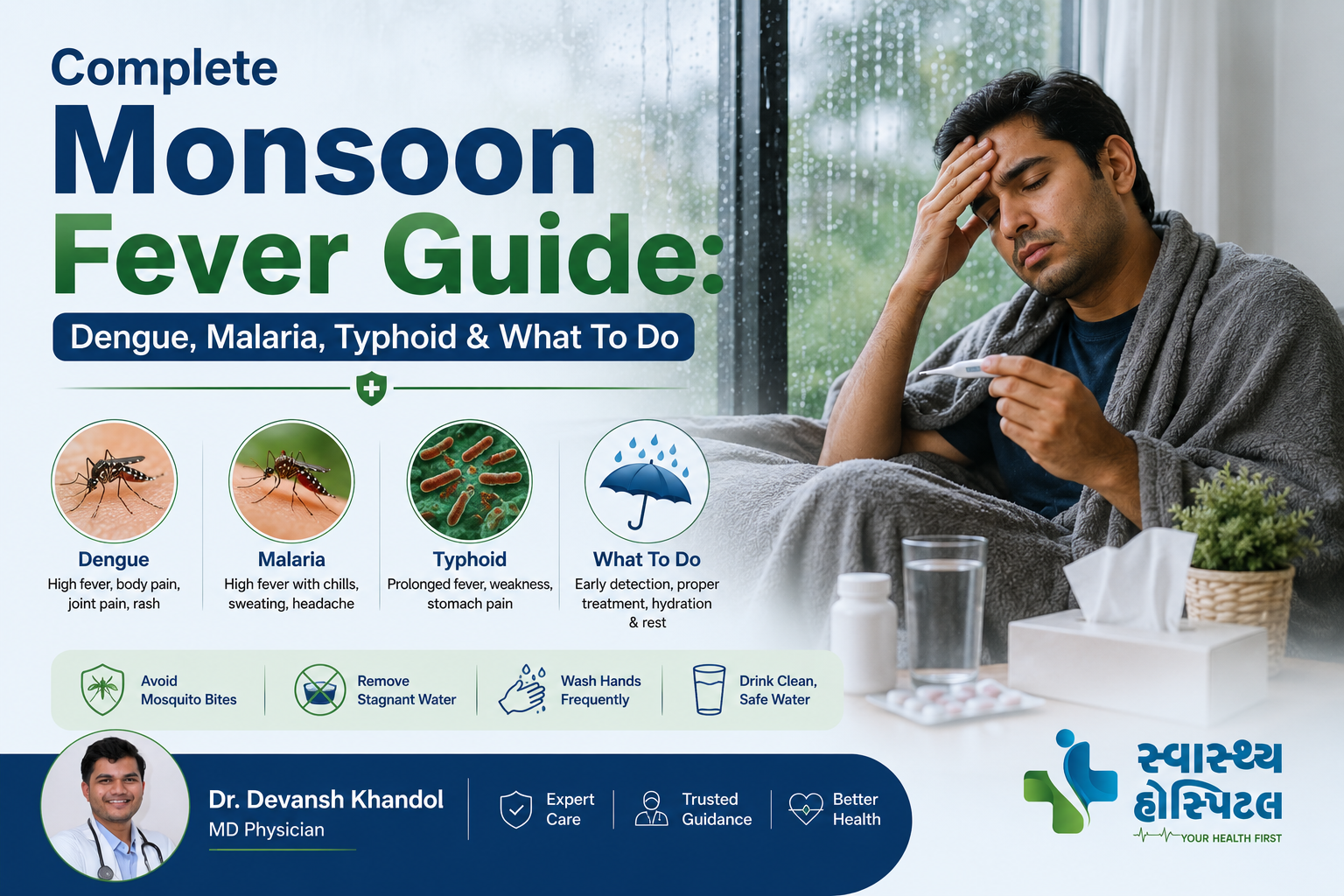
Complete Monsoon Fever Guide for Gandhidham: Dengue, Malaria, Typhoid & What To Do
Monsoon fever Gandhidham cases follow a predictable pattern every year, and the predictability is the point - knowing what to expect is what lets families act early instead of waiting out a fever that turns out to be more than a fever. Dengue, malaria, and typhoid all peak in the same window, and the early symptoms overlap closely enough that guessing is the wrong strategy.
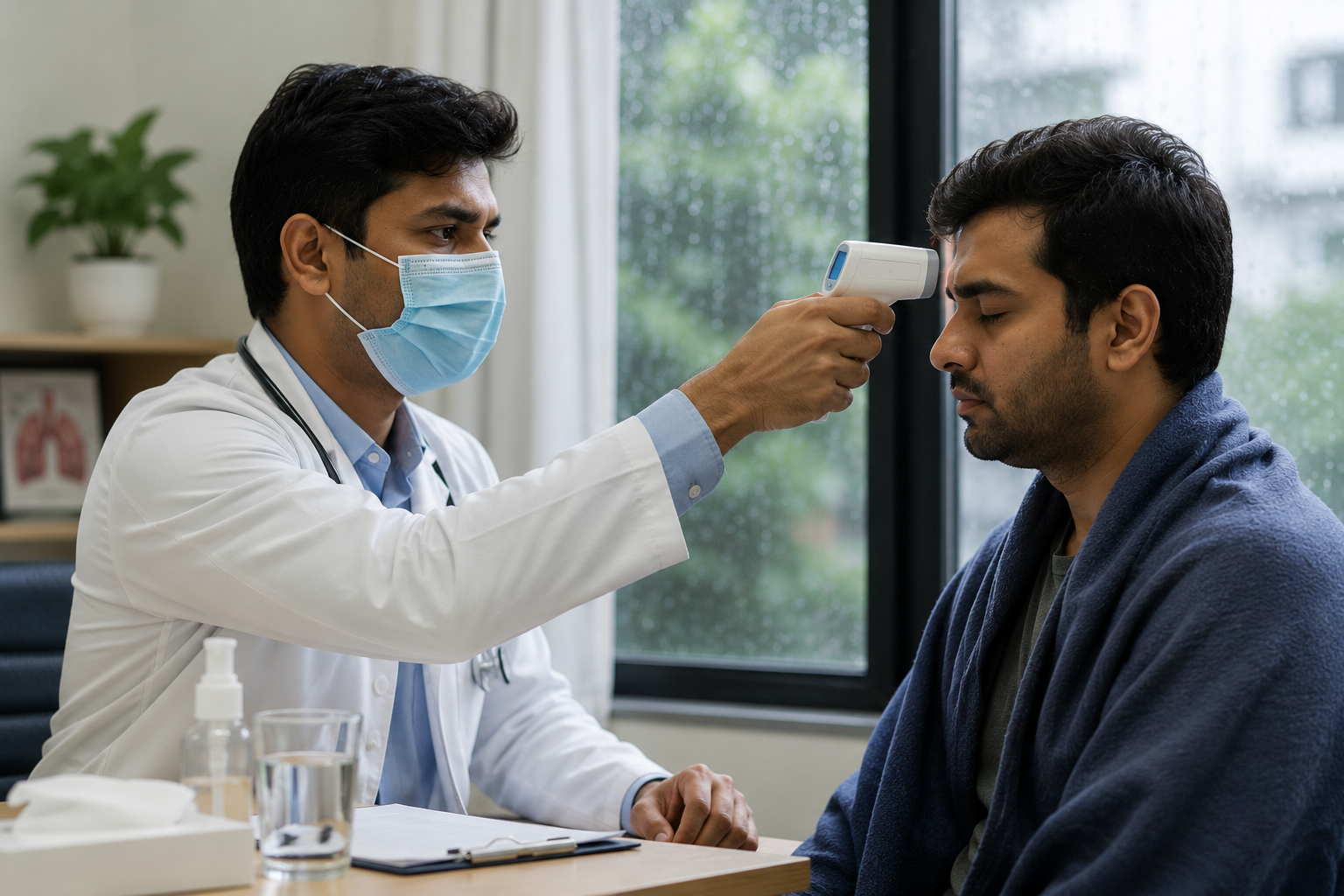
Early evaluation during monsoon season helps distinguish dengue, malaria, and typhoid before symptoms worsen.
Why Monsoon Fever Gandhidham Risk Stays High Every Year
Several factors make monsoon fever Gandhidham cases so consistent year after year. The terrain holds water in low-lying pockets after heavy rain, creating exactly the stagnant conditions mosquitoes need to breed for dengue and malaria. The same first-flush contamination that affects food and drinking water also raises typhoid risk through unboiled or unfiltered sources. Add limited primary care access in several outlying pockets around Gandhidham, and a fever that could have been caught early sometimes gets diagnosed only once it has progressed.
Dengue vs. Malaria vs. Typhoid - The Comparison
Telling the three apart matters for monsoon fever Gandhidham cases, because the right next step is different for each one.
Dengue vs. Malaria vs. Typhoid: Symptom Comparison
| Feature |
Dengue |
Malaria |
Typhoid |
| Onset |
Sudden, high fever |
Cyclical fever with chills |
Gradual, step-ladder rise |
| Key symptoms |
Severe headache, joint and muscle pain, pain behind the eyes, reduced appetite, nausea or vomiting |
Fever spikes with chills and sweating, fatigue |
Sustained fever, abdominal discomfort, constipation or loose stools |
| Rash |
Common, appears day 3 to 5 |
Rare |
Rare, occasional rose-colored spots |
| Danger signs |
Bleeding gums, black stools, severe abdominal pain, low platelet count |
Confusion, repeated seizures, breathing difficulty |
Abdominal rigidity, severe distension, signs of perforation |
Hospital or Home Care - The Red Flag List
Most monsoon fevers can be monitored at home in the first 24 to 48 hours with rest, fluids, and paracetamol; avoid aspirin or ibuprofen until a diagnosis rules out dengue. Go to a hospital without waiting if there is bleeding from the gums or nose, black or tarry stools, severe or persistent abdominal pain, confusion or unusual drowsiness, repeated vomiting that prevents fluid intake, difficulty breathing, or a fever above 103°F or continuous fever above 101°F that does not respond to medication. Any of these, in a child, an elderly patient, or a pregnant woman, warrants moving even faster.
Red flag reminder: bleeding gums, black stools, confusion, breathing difficulty, or a fever that won't break with medication means hospital - not a wait-and-see approach.
The Fever-Diabetes Link
Diabetic patients carry an additional layer of risk that monsoon fever Gandhidham advice often skips. Infection raises blood sugar through stress hormones, and high blood sugar in turn weakens the immune response, creating a cycle that can turn a routine fever into a longer, harder illness. Diabetic patients with any monsoon fever need specialist-level monitoring through endocrinology care, not just symptom management, because dengue's platelet drop and typhoid's gut involvement both interact poorly with poorly controlled glucose. The same caution applies to patients on long-term immunosuppressive treatment for chronic conditions managed through rheumatology care - their reduced immune response can blur early warning signs and delay the moment a fever is recognized as serious.
Why Antibiotic Misuse Needs to Stop
One pattern doctors see every monsoon deserves direct mention: antibiotic misuse. Dengue and malaria are not bacterial infections, and antibiotics do nothing against them, yet they are still reached for out of habit or pressure for a quick fix. Unnecessary antibiotic use during the monsoon fever Gandhidham experiences every year delays the correct diagnosis, contributes to antibiotic resistance, and can mask symptoms that would otherwise prompt urgent care. If a fever is bacterial, like typhoid, the right antibiotic still depends on a confirmed diagnosis first - which is exactly the role infectious disease care plays in getting treatment right the first time.
How These Fevers Are Actually Diagnosed
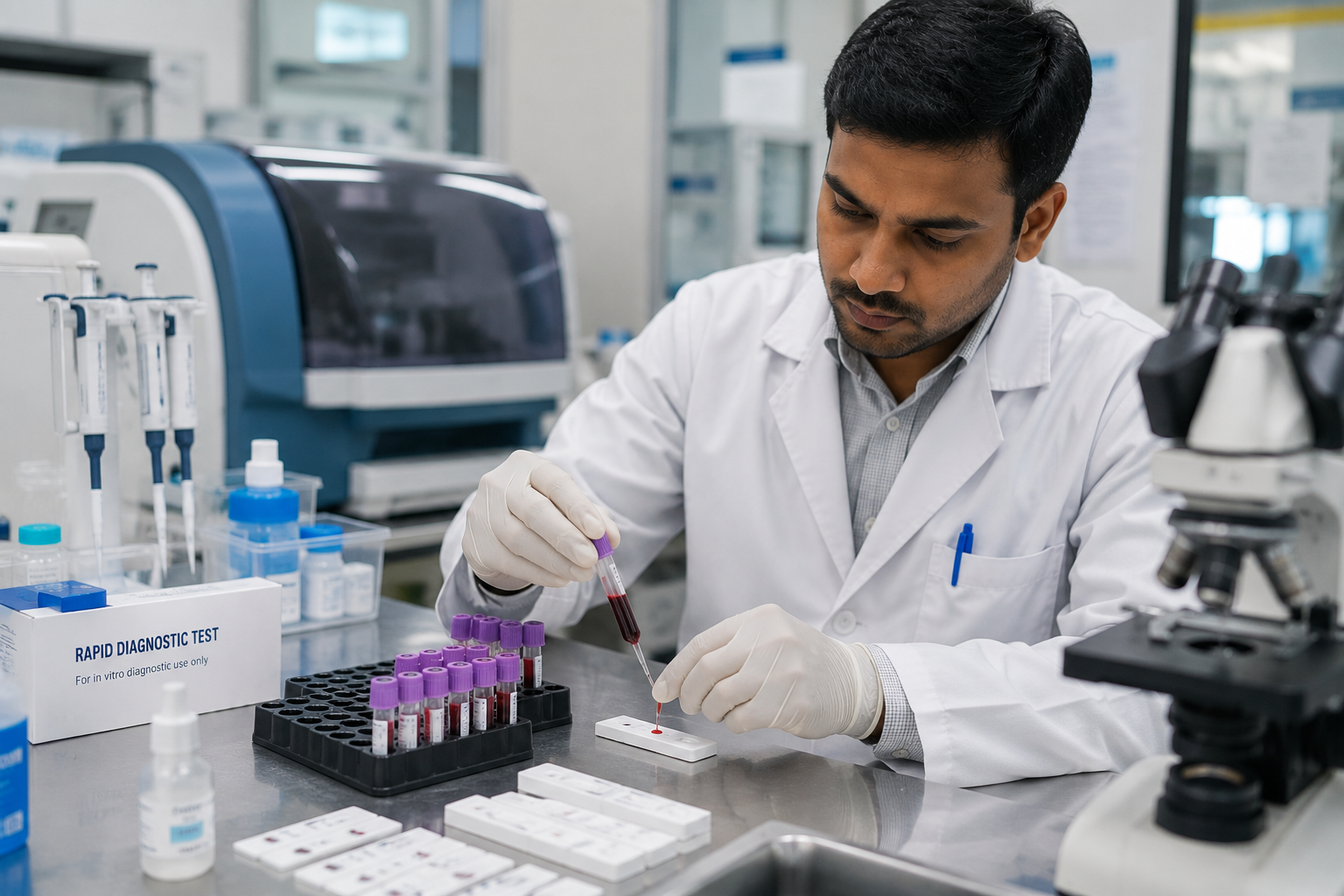
Diagnosis itself is straightforward once a doctor orders the right test. Dengue is confirmed through an NS1 antigen test in the first few days of fever, or a dengue IgM antibody test slightly later in the illness. Malaria is confirmed with a rapid diagnostic test or a blood smear examined under a microscope. Typhoid is confirmed through a Widal test or, more reliably, a blood culture. None of these require guesswork once a patient is in front of a doctor who orders them at the right time.
NS1, rapid diagnostic tests, and blood cultures confirm the exact cause of a monsoon fever before treatment begins.
Meet Dr. Devansh Khandol
Dr. Devansh Khandol brings internal medicine expertise to exactly this kind of diagnostic decision-making, evaluating monsoon fever cases at Swasthya Hospital's OPD and deciding which tests are needed and when a fever has crossed from manageable to urgent. For Gandhidham families dealing with a monsoon fever that does not fit a clean pattern, that evaluation is the fastest way to a clear answer.
What To Do Right Now
If your fever, or a family member's, matches any of the danger signs above, do not wait for an appointment slot - go to the hospital. For everything short of that, OPD evaluation at Swasthya Hospital is available to confirm which monsoon fever - dengue, malaria, or typhoid - a patient in Gandhidham is dealing with this season, and to start the right treatment instead of a guess.
{
"@context": "https://schema.org",
"@type": "MedicalWebPage",
"headline": "Complete Monsoon Fever Guide for Gandhidham: Dengue, Malaria, Typhoid & What To Do",
"description": "Monsoon fever Gandhidham can mean dengue, malaria, or typhoid. Compare symptoms, know the red flags, and learn when to see a doctor versus manage at home.",
"url": "https://www.swasthyahospital.com/blog/monsoon-fever-gandhidham-dengue-malaria-typhoid-guide",
"datePublished": "2026-06-16",
"dateModified": "2026-06-23",
"author": { "@type": "Person", "name": "Dr. Devansh J Khandol", "jobTitle": "Internal Medicine Specialist" },
"publisher": {
"@type": "Organization",
"name": "Swasthya Hospital",
"logo": { "@type": "ImageObject", "url": "https://www.swasthyahospital.com/images/logo.png" }
},
"about": [
{ "@type": "MedicalCondition", "name": "Dengue fever" },
{ "@type": "MedicalCondition", "name": "Malaria" },
{ "@type": "MedicalCondition", "name": "Typhoid fever" }
],
"mainEntityOfPage": {
"@type": "WebPage",
"@id": "https://www.swasthyahospital.com/blog/monsoon-fever-gandhidham-dengue-malaria-typhoid-guide"
}
}
{
"@context": "https://schema.org",
"@type": "FAQPage",
"mainEntity": [
{
"@type": "Question",
"name": "How can I tell if my fever is dengue, malaria, or typhoid?",
"acceptedAnswer": { "@type": "Answer", "text": "Dengue starts suddenly with severe headache and pain behind the eyes, often with a rash by day 3 to 5. Malaria causes cyclical fever with chills and sweating. Typhoid builds gradually with a step-ladder fever and abdominal discomfort. Testing confirms which one." }
},
{
"@type": "Question",
"name": "When should I go to the hospital instead of treating fever at home?",
"acceptedAnswer": { "@type": "Answer", "text": "Go immediately if there is bleeding from the gums or nose, black stools, severe abdominal pain, confusion, repeated vomiting, breathing difficulty, or fever above 103 degrees Fahrenheit that medication doesn't bring down. Children, elderly patients, and pregnant women should move faster on any of these." }
},
{
"@type": "Question",
"name": "Why is monsoon fever more dangerous for diabetic patients?",
"acceptedAnswer": { "@type": "Answer", "text": "Infection raises blood sugar through stress hormones, and high blood sugar weakens immune response, creating a cycle that worsens the illness. Dengue's platelet drop and typhoid's gut involvement both interact poorly with uncontrolled glucose, so diabetic patients need specialist-level monitoring." }
},
{
"@type": "Question",
"name": "Is it safe to take antibiotics for a monsoon fever?",
"acceptedAnswer": { "@type": "Answer", "text": "Not without a diagnosis. Dengue and malaria are not bacterial, so antibiotics do nothing against them and can delay correct diagnosis. Typhoid does need antibiotics, but the right one depends on a confirmed test result, not a guess." }
},
{
"@type": "Question",
"name": "What tests confirm dengue, malaria, or typhoid?",
"acceptedAnswer": { "@type": "Answer", "text": "Dengue is confirmed with an NS1 antigen test early on, or a dengue IgM test later. Malaria is confirmed with a rapid diagnostic test or blood smear. Typhoid is confirmed with a Widal test or, more reliably, a blood culture." }
},
{
"@type": "Question",
"name": "How do I see Dr. Devansh Khandol for a monsoon fever evaluation?",
"acceptedAnswer": { "@type": "Answer", "text": "Dr. Khandol, an internal medicine specialist, evaluates monsoon fever cases through Swasthya Hospital's OPD, deciding which tests are needed and whether a fever requires urgent care. Walk-in OPD evaluation is available for fevers that don't fit a clean pattern." }
}
]
}
{
"@context": "https://schema.org",
"@type": "Physician",
"name": "Dr. Devansh J Khandol",
"medicalSpecialty": "Internal Medicine",
"worksFor": {
"@type": "Hospital",
"name": "Swasthya Hospital",
"address": {
"@type": "PostalAddress",
"addressLocality": "Gandhidham",
"addressRegion": "Gujarat",
"addressCountry": "IN"
}
},
"url": "https://www.swasthyahospital.com/doctors/dr-devansh-khandol"
}