
Does Every Chest Pain Need an ECG? What Doctors Check First
For almost everyone with new chest pain, an ECG is the first test. A normal ECG does not always rule out a heart attack, which is why doctors repeat it and check a blood test called troponin.
If you have these symptoms, call emergency services now (108 or 112)
- Chest pain that feels like pressure, tightness or squeezing
- Pain spreading to the arm, neck, jaw or back
- Breathlessness, sweating, nausea or feeling faint with the pain
- Do not drive yourself. Do not wait to see if it passes.
Does chest pain need an ECG? For nearly everyone with new chest pain or discomfort, yes, because it is the quickest way to look for signs of a heart problem. It does not hurt and takes only a few minutes. It is not the only test, though. A normal ECG does not always exclude a heart attack, so doctors may repeat it and use a blood test called troponin. Not every chest pain is from the heart, but you cannot tell at home. Here is why the ECG comes first, when it is an emergency, and what happens next.
Why Is an ECG the First Test for Chest Pain?
An electrocardiogram (ECG) records the electrical activity of your heart, including its rate and rhythm. Doctors use it when they suspect a heart attack, coronary heart disease or a rhythm problem (NHS, 2023). Small sticky pads are placed on your chest, arms and legs, and you lie still for a few minutes.
The 2021 American guideline on chest pain, from the AHA and ACC, treats the ECG as a core early test for both sudden and stable chest pain. A summary of the guideline for doctors says an ECG should be done within 10 minutes of arrival at a clinic or emergency department (AAFP, 2023). That speed matters because treatment for a blocked heart artery works best when started early.
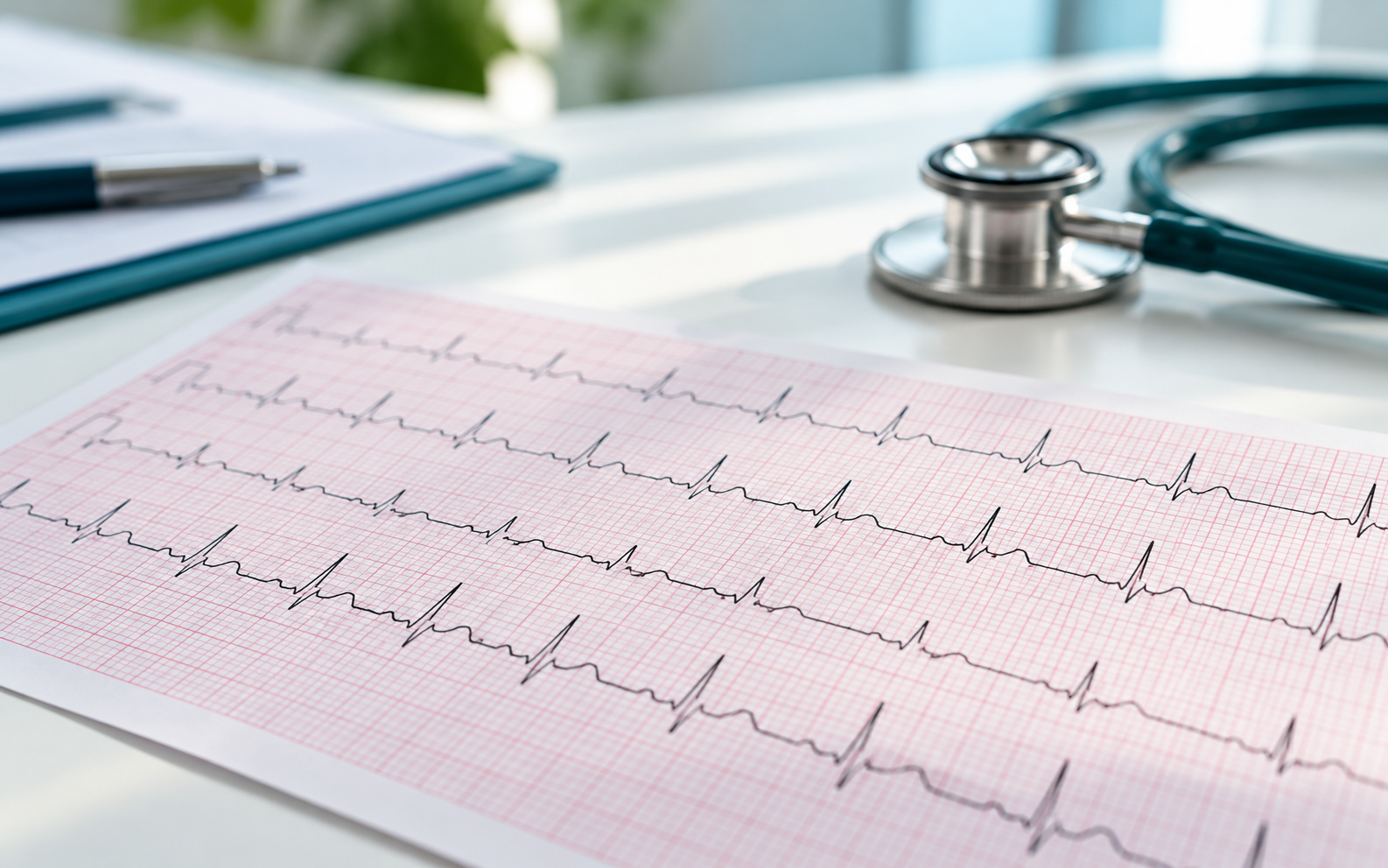
Illustration generated with AI.
Can an ECG Be Normal in a Heart Attack?
Yes, it can, especially early on. An ECG is a snapshot of one moment. If the changes are not yet visible, or are subtle, the first ECG can look normal.
That is why doctors often:
- Repeat the ECG after a short interval.
- Check troponin, a blood test that rises when heart muscle is injured. The 2021 guideline prefers high-sensitivity troponin for diagnosing a heart attack.
- Observe you for some hours if your story and risk factors are concerning.
So a normal first ECG is reassuring, but it is not always the final answer. Do not leave early against advice because your first ECG was normal.
Which Chest Pain Symptoms Are Emergencies?
The NHS lists these heart attack features (NHS, reviewed March 2026): chest pain that feels tight or like squeezing, pain spreading to the arms, neck or jaw, severe difficulty breathing, and pale, sweaty or grey skin. Nausea, vomiting and feeling like you have indigestion can also occur. The NHS advises not to drive yourself to the hospital.
Heart attacks do not always look like the films. In older adults, women and people with diabetes, symptoms may be milder or atypical, such as breathlessness, unusual tiredness, nausea or upper-abdominal discomfort. If you are unsure, treat it as urgent.
Can Chest Pain Be Gas or Muscle Pain Instead?
Yes. Many chest pains come from the food pipe (acid reflux), a strained chest-wall muscle, an inflamed rib joint, anxiety, or lung problems. But symptoms overlap, and doctors cannot reliably tell the cause from the description alone. That is why a test is done first.
| Feature | Tends to point toward the heart | Tends to point elsewhere |
|---|---|---|
| Quality | Pressure, tightness, heaviness | Sharp, stabbing, localised to one spot |
| Trigger | Walking, stairs, stress, cold | Eating, lying flat (reflux), pressing on the chest, deep breath or movement |
| Spread | Arm, neck, jaw, back | Usually stays in one place |
| With it | Sweating, breathlessness, nausea, faintness | Sour taste, burping, tender chest wall |
This table is for general understanding only. Any of these features can appear in either group, and it is not safe to decide at home. If it is new, severe, or you have risk factors, get checked.
What Happens at the Hospital When You Arrive With Chest Pain?
Our cardiology department lists digital ECG, 2D echocardiography, multipara monitoring and cardiac biomarker testing (troponin and BNP). A typical pathway is:
- Triage and vital signs: pulse, blood pressure, oxygen level and a short history.
- ECG, usually done promptly.
- Monitoring of your heart rate and blood pressure.
- Blood tests, including troponin where needed, and repeat ECGs.
- Further tests only if needed, such as a 2D echo to look at the heart's pumping and valves (see our ECG and 2D echo facilities).
- A plan: treatment, observation, referral, or safe discharge with advice.
The exact steps depend on your symptoms and results.
Illustration generated with AI.
Who Should Be Extra Careful With Chest Pain?
Take chest pain more seriously if you have high blood pressure (read about hypertension in young men), diabetes, smoke or chew tobacco, have high cholesterol, are over 40, or have a family history of early heart disease. High blood pressure often has no symptoms; the WHO estimates that 44% of adults with hypertension do not know they have it (WHO, 2025).
In October 2023, The National reported at least 10 deaths from heart attacks within 24 hours among people at Garba events in Gujarat, and the state asked organisers to keep ambulances available (The National, 23 October 2023). Stop dancing and seek help if you feel chest pain, breathlessness or faintness.
Frequently Asked Questions
Should I take an aspirin if I have chest pain?
Do not decide this on your own. Call emergency services and follow the instructions you are given.
Can anxiety cause chest pain?
Yes, but you should not assume it. Get a heart cause ruled out first.
How long does an ECG take?
Usually only a few minutes. It is non-invasive and does not normally cause pain.
If my ECG is normal, can I ignore my chest pain?
Not if the pain continues, comes with exertion, or you have risk factors. Tell your doctor, who may advise repeat testing or other tests.
Chest Pain Right Now?
Call emergency services (108 or 112). For non-urgent questions about heart symptoms, contact our cardiology department. The hospital is open 24x7 in Gandhidham.
Contact the HospitalLearn more about our cardiology department and our ECG and 2D echo facilities. Also read: stroke warning signs and the golden hour.
- Gulati M, Levy PD, Mukherjee D, et al. 2021 AHA/ACC/ASE/CHEST/SAEM/SCCT/SCMR Guideline for the Evaluation and Diagnosis of Chest Pain. Circulation. 2021;144(22):e368-e454. doi:10.1161/CIR.0000000000001029. https://doi.org/10.1161/CIR.0000000000001029
- American Academy of Family Physicians. Chest pain evaluation: updated guidelines from the AHA/ACC. American Family Physician, February 2023. https://www.aafp.org/afp/2023/0200/practice-guidelines-chest-pain-evaluation
- NHS. Electrocardiogram (ECG). Page last reviewed 9 November 2023. https://www.nhs.uk/conditions/electrocardiogram/
- NHS. Heart attack. Page last reviewed 31 March 2026. https://www.nhs.uk/conditions/heart-attack/
- World Health Organization. Hypertension (fact sheet), 25 September 2025. https://www.who.int/news-room/fact-sheets/detail/hypertension
- Dutta T. 10 die of heart attacks within 24 hours at garba events in Gujarat. The National, 23 October 2023. https://www.thenationalnews.com/world/asia/2023/10/23/garba-gujarat-heart-attack/