
Garba Knee Pain: How to Dance Navratri Nights Without Hurting Your Joints
Most Garba knee pain is overuse, not damage, and a good warm-up, the right shoes and some pacing prevent much of it. A few signs mean it is time to see a doctor.
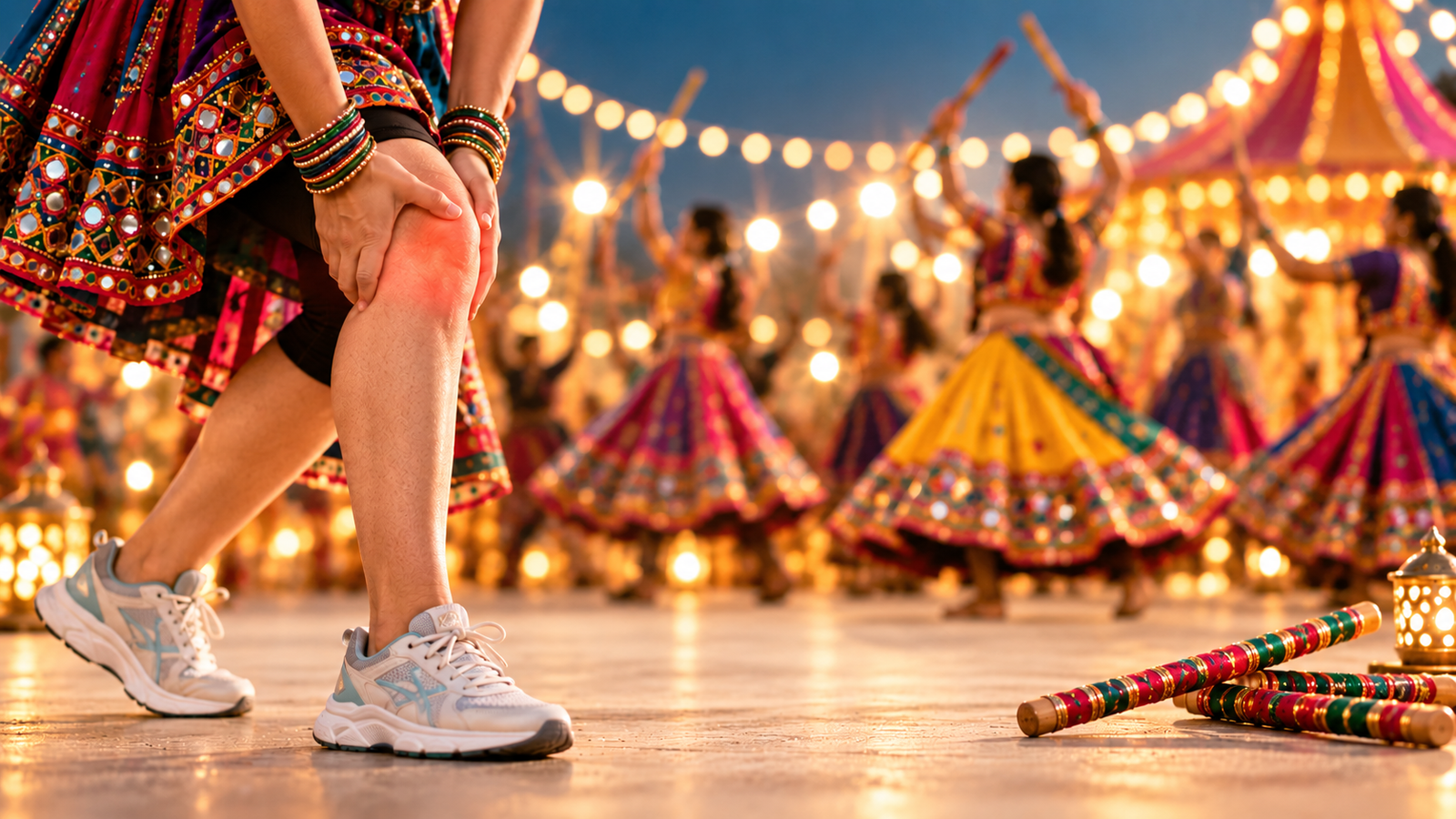
Illustration generated with AI.
Garba knee pain is very common, and in most people it comes from sudden overuse rather than lasting damage. Hours of bouncing, turning and deep steps on knees that have been mostly sitting all year is a lot to ask. A short warm-up, supportive footwear, safer turning and regular breaks protect most knees. But some pain is a sign of arthritis or an injury, and you should not dance through it. Here is how to protect your joints for the rest of Navratri, what to do if they already hurt, and when to see a doctor.
Why Does Garba Make Your Knees Hurt?
Garba is a workout most of us do once a year. Several things add up:
- A sudden jump in activity. Going from desk work to three or four hours of dancing, night after night, gives muscles and joints no time to adapt.
- Repeated bounce and deep steps. Each landing sends force through the knee, and the knee has to absorb it hundreds of times in an evening.
- Turning on a planted foot. Spinning with your foot fixed on the ground twists the knee, which is built to bend and straighten rather than rotate.
- Hard ground and the wrong shoes. Concrete grounds, thin soles or bare feet give little cushioning.
- Heavy outfits. A heavy chaniya choli or kediyu can restrict your steps and shift how you move.
- No recovery. Nine nights in a row leave little time for tired tissues to settle.
Muscle soreness usually appears as a general ache around the knee that eases with gentle movement. Pain inside the joint, swelling, or a knee that catches or gives way points to something more.
Who Is More Likely to Get Knee Pain From Garba?
Anyone can, but some knees are more vulnerable. If you recognise yourself below, pace yourself more carefully and speak to a doctor if pain persists.
| Who | Why the risk is higher | What helps |
|---|---|---|
| People with knee osteoarthritis | Worn cartilage reacts to repeated impact | Shorter sessions, more breaks, a doctor's advice before the season |
| Past knee injury (ligament, meniscus) | The joint may be less stable | Supportive footwear, avoid sharp turns, consider a knee brace if your doctor advises |
| Overweight | More load goes through each step | Build up gradually, avoid long unbroken rounds |
| Age 40 and above | Joint degeneration becomes more likely with age | Warm up well, rest between rounds |
| Inflammatory arthritis or gout | Joints can flare with activity, fasting or dehydration | Keep taking prescribed medicines and ask your doctor before Navratri fasting |
| Little regular exercise | Muscles around the knee are not conditioned | Start a short daily walk well before the season next year |
Osteoarthritis is common in India. A 2025 systematic review of 14 community studies found that about 47% of Indians aged 60 and above had knee osteoarthritis, though the individual studies ranged widely, from 15% to 70% (Daniel et al., 2025). The figure will not apply to you personally, but it shows why knee care matters.
How Can You Protect Your Knees While Dancing Garba?
These habits take little time and make a real difference:
- Warm up for 5 to 10 minutes before the first round. Walk briskly, do gentle leg swings, and bend and straighten your knees slowly. Do not go straight from the car to the circle.
- Wear shoes with cushioning and grip. Choose flat, supportive footwear where the ground allows it. Avoid slippery soles.
- Lift and turn instead of twisting. When you spin, pick your foot up and pivot with your whole body. Do not leave your foot planted while the knee twists.
- Keep your knees soft. Bend slightly on landing and let your knees line up over your toes, rather than locking them straight or letting them fall inward.
- Build up gradually. Start with shorter sessions on the first nights if you have not been active, and increase slowly.
- Take breaks and drink water. Rest for a few minutes between rounds. If you sweat heavily, make ORS at home using the WHO recipe.
- Eat a proper meal first. Dancing hard on an empty stomach, especially during a fast, raises the risk of dizziness and falls. See our note on whether an IV drip is worth it before Navratri.
- Cool down and stretch gently afterwards, and try to sleep well. Sleep is when tissues recover.
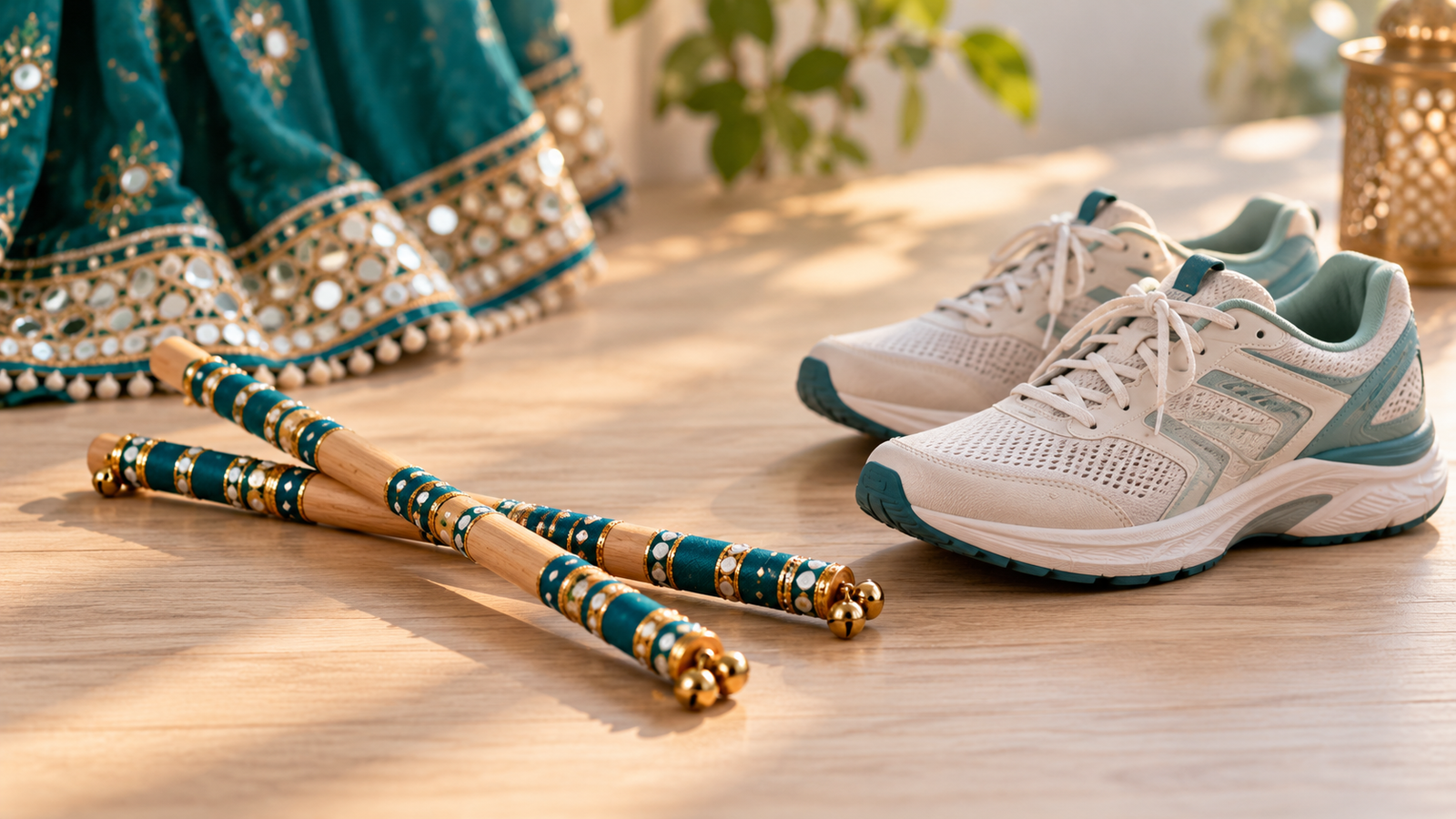
Illustration generated with AI.
What Should You Do If Your Knees Hurt After Garba?
For ordinary overuse soreness, a few steps usually help:
- Rest the knee for a day or two, but keep walking gently. Total bed rest slows recovery.
- Use a cold pack wrapped in a cloth for 15 to 20 minutes, a few times a day, if the knee feels sore or puffy.
- Raise your leg when sitting and avoid deep squatting or climbing many stairs while it settles.
- Be careful with painkillers. Common anti-inflammatory painkillers (NSAIDs, such as ibuprofen or diclofenac) can raise blood pressure and can irritate the stomach and kidneys. Ask a doctor or pharmacist first if you have high blood pressure, kidney disease or acidity, and avoid taking them for days on end.
- Do not dance through sharp or worsening pain. Skip a night. One missed round is better than a month of pain.
When Should You See a Doctor for Knee Pain?
See a doctor urgently if
- You cannot put weight on the leg, or the knee gives way.
- The knee locks, or you heard a pop followed by quick swelling.
- The joint is hot, red and very swollen, especially with fever.
- The knee looks deformed after a fall.
- Your calf is swollen, painful and warm on one side.
Arrange a routine appointment if pain or swelling does not settle in about two weeks, if it keeps waking you at night, if you have morning stiffness that lasts a long time, or if several joints hurt. These patterns can mean arthritis that dancing has exposed, not just overuse. A rheumatologist can examine you, order the right tests and start treatment early.
A different kind of warning
Chest pain, pressure in the chest, breathlessness, a racing heartbeat or fainting while dancing is not a knee problem. Stop, sit down and call emergency services (108 or 112).
Can Regular Exercise Actually Protect Your Knees?
Yes. The World Health Organization says osteoarthritis is not an unavoidable result of ageing, and that exercise and a healthy weight reduce symptoms (WHO, 2023). A 2024 Cochrane review of exercise for knee osteoarthritis found that exercise likely reduces pain and improves movement in the short term, although the certainty of the evidence is low to moderate (Lawford et al., 2024). So a daily walk or leg-strengthening routine through the year does more for your knees than any one-off fix before the festival.
Frequently Asked Questions
Is it normal for knees to ache after Garba?
Mild, general soreness that settles within a few days is common after hours of dancing. Pain that is sharp, centred in the joint, comes with swelling, or lasts more than about two weeks should be checked.
Should I wear a knee brace for Garba?
A brace can help some people with a past injury or arthritis, but it is not for everyone and does not replace conditioning. Ask your doctor before relying on one.
Can I dance Garba if I have knee arthritis?
Many people with mild knee arthritis can, with shorter sessions, rest breaks and good shoes. Talk to your doctor first, particularly if you have swelling or pain at rest.
Is it safe to take a painkiller before dancing?
Taking a painkiller to dance through pain can hide an injury and make it worse. Anti-inflammatory tablets also carry risks for blood pressure, stomach and kidneys. Speak to a doctor first.
Questions About Knee Pain?
If your knees still hurt or swell after Navratri, our rheumatology department can advise. The hospital is open 24x7 in Gandhidham.
Contact the HospitalLearn more about our rheumatology department.
- World Health Organization. Osteoarthritis (fact sheet), 14 July 2023. https://www.who.int/news-room/fact-sheets/detail/osteoarthritis
- Lawford BJ, Hall M, Hinman RS, et al. Exercise for osteoarthritis of the knee. Cochrane Database of Systematic Reviews. 2024;(12):CD004376. doi:10.1002/14651858.CD004376.pub4. https://doi.org/10.1002/14651858.CD004376.pub4
- Daniel RA, Kalaivani M, Aggarwal P, Gupta SK. Prevalence of knee osteoarthritis among elderly persons in India: a systematic review and meta-analysis. J Family Med Prim Care. 2025;14(5):1675-1684. doi:10.4103/jfmpc.jfmpc_1254_24. PMID: 40547750. https://doi.org/10.4103/jfmpc.jfmpc_1254_24