

BPH (Enlarged Prostate): Early Symptoms, Stages, Treatment, and When Surgery Is Needed
Waking up two or three times a night to urinate isn't just "getting older" - it's often the first sign of BPH. Here's how to recognise it early, what the stages mean, and when treatment actually becomes necessary.

Benign Prostatic Hyperplasia (BPH), commonly called an enlarged prostate, is one of the most common conditions in ageing men - and one of the most quietly tolerated. Many men live with worsening urinary symptoms for years, assuming it's a normal part of getting older, before ever mentioning it to a doctor. It is extremely common, it is manageable at every stage, and in a large number of cases it does not need medication or surgery at all. Knowing where you actually stand starts with understanding the symptoms, the stages, and what each treatment option is really meant to do.
What Is BPH, and Why Does It Almost Always Show Up With Age?
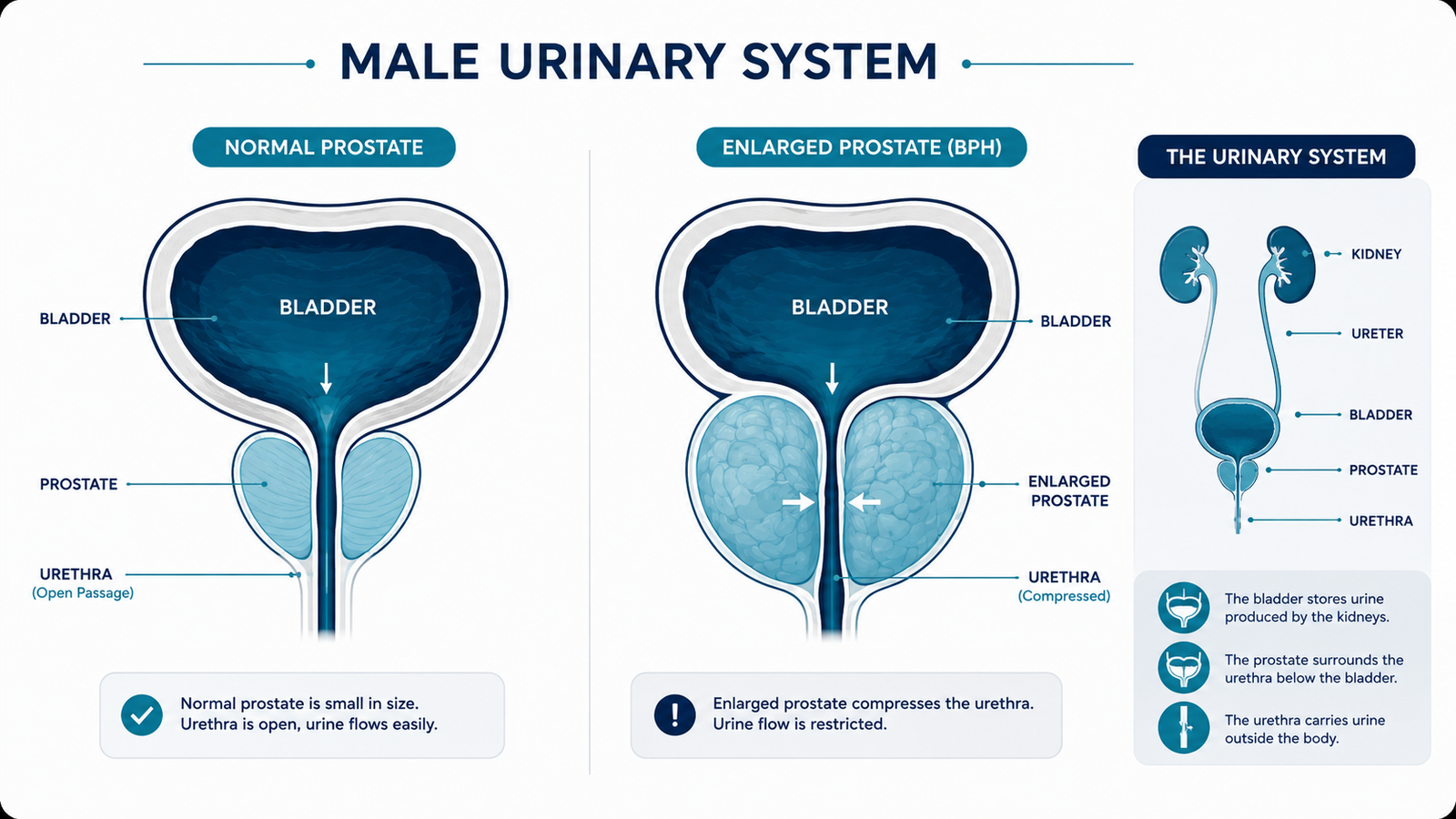
The prostate is a small gland that sits just below the bladder, surrounding the urethra - the tube that carries urine out of the body. As men age, hormonal changes (particularly the ongoing effect of dihydrotestosterone, or DHT, on prostate tissue) cause the gland to keep growing slowly throughout adult life. This growth is non-cancerous - "benign" - but as the prostate enlarges, it can squeeze the urethra and partially obstruct urine flow.
This is why BPH affects elderly men specifically: it is a near-universal consequence of prostate tissue's continued exposure to hormones over decades, not a disease process that appears suddenly. According to the National Institute of Diabetes and Digestive and Kidney Diseases (NIDDK), roughly half of men have some degree of prostate enlargement by their 50s, and the proportion rises to around 80–90% by the 70s and 80s. Age is, by far, the single biggest risk factor - which is exactly why most men eventually experience at least mild symptoms if they live long enough.
Basic Symptoms of BPH Men Often Dismiss
BPH symptoms are collectively called lower urinary tract symptoms (LUTS), and they develop so gradually that most men adjust their habits around them rather than flagging them as a medical issue. The common early symptoms include:
- Frequent urination, especially needing to go every 1–2 hours
- Nocturia - waking up multiple times at night to urinate
- Urgency - a sudden, hard-to-control need to urinate
- Weak or interrupted urine stream, or having to strain to start
- A feeling of incomplete bladder emptying even right after urinating
- Dribbling at the end of urination
Individually, each of these can feel minor. Together, and worsening over months or years, they point toward BPH - and they are worth mentioning at a routine check-up rather than working around indefinitely.
The Stages of BPH - Mild, Moderate, and Severe
Doctors classify BPH severity using a standardised questionnaire - the International Prostate Symptom Score (IPSS), also known as the American Urological Association (AUA) Symptom Index. It scores seven symptoms (frequency, urgency, weak stream, straining, incomplete emptying, intermittency, and nocturia) on a 0–35 scale, and the total score defines the stage.
| Stage | IPSS Score | What It Typically Looks Like |
|---|---|---|
| Mild | 0–7 | Occasional symptoms, minimal disruption to daily life or sleep |
| Moderate | 8–19 | Regular symptoms affecting sleep, routine, or quality of life |
| Severe | 20–35 | Significant symptoms, risk of complications (retention, bladder or kidney impact) |
The score is only part of the picture - how much a symptom actually bothers a patient matters just as much clinically. A man with a "moderate" score who isn't troubled by his symptoms may be managed very differently from one with the same score who finds it disruptive.
Not Everyone With BPH Needs Medication or Surgery
This is the point that gets lost most often: a diagnosis of BPH is not automatically a prescription. For men in the mild category - and many in the lower end of moderate - the standard, guideline-backed approach is watchful waiting combined with simple lifestyle adjustments:
- Reducing fluid intake in the evening, especially before bed
- Cutting back on caffeine and alcohol, both of which irritate the bladder
- Avoiding decongestants and antihistamines that can worsen urinary retention
- Timed or "double" voiding techniques to improve bladder emptying
- Routine follow-up to track whether symptoms are stable or progressing
Medication and surgery exist for men whose symptoms are bothersome enough to affect daily life, or who develop specific complications - not as a default response to any degree of prostate enlargement. Overtreating mild, non-bothersome BPH exposes a patient to side effects for no meaningful benefit.
When Should Treatment Actually Start?
Treatment is generally recommended to begin when one or more of the following is true, rather than being tied to a specific age:
- The IPSS score is in the moderate-to-severe range and the symptoms are genuinely bothersome
- Symptoms are worsening on follow-up visits despite lifestyle changes
- Sleep or daily activities are being meaningfully disrupted by urinary symptoms
- Early signs of complications appear, such as difficulty starting urination or a sense of poor bladder emptying that isn't improving
In other words, the decision to start treatment is driven by symptom severity and impact - not by the diagnosis of BPH alone, and not by age.
What Do BPH Drugs Actually Do?
The two main medication classes work in completely different ways, which is why they're often compared but not interchangeable:
| Medication Class | How It Works | What to Expect |
|---|---|---|
| Alpha-blockers (e.g. tamsulosin, alfuzosin) |
Relax the smooth muscle of the prostate and bladder neck, easing urine flow | Symptom relief within days; does not shrink the prostate |
| 5-alpha-reductase inhibitors (e.g. finasteride, dutasteride) |
Block the hormone (DHT) that drives prostate growth, gradually shrinking gland size | Takes 3–6 months for full effect; most useful for larger prostates |
For many men with larger prostates and more significant symptoms, doctors prescribe both together - the alpha-blocker for quick relief while the 5-alpha-reductase inhibitor works on the underlying gland size over months. Neither drug class cures BPH; they manage it, and symptoms typically return if the medication is stopped without another intervention in place.
When Should One Get Operated?
Surgery for BPH is considered either when medication hasn't worked well enough, or immediately, regardless of symptom score, when specific complications develop. These are generally accepted as clear indications for surgical treatment:
- Acute or recurrent urinary retention (complete inability to urinate)
- Recurrent urinary tract infections caused by incomplete bladder emptying
- Bladder stones forming due to residual urine
- Kidney impairment caused by back-pressure from a chronically obstructed bladder
- Recurrent visible blood in urine traced to prostate enlargement
- Failure of medication to adequately control bothersome symptoms
Surgical options range from the long-standing standard, TURP (transurethral resection of the prostate), to newer laser-based and minimally invasive techniques, chosen based on prostate size, overall health, and the patient's specific situation. The point to take away is that surgery is a response to a defined threshold being crossed - not the automatic next step after medication is tried once.
Role of S. PSA and When It Should Be Done
The Prostate-Specific Antigen (PSA) blood test measures a protein produced by the prostate. It is not a test specifically "for BPH" - it is primarily used to help rule out prostate cancer, since both BPH and prostate cancer can raise PSA levels. This overlap is exactly why PSA needs to be interpreted by a doctor alongside a physical exam, not read in isolation.
General guidance, including from bodies referenced by the American Cancer Society and Johns Hopkins Medicine, suggests:
- A baseline discussion with a doctor around age 50 for average-risk men
- Earlier discussion, around age 40–45, for men with a family history of prostate cancer
- PSA testing alongside a digital rectal exam when urinary symptoms are already present, to evaluate both BPH and rule out other causes
- Ongoing PSA monitoring for men already diagnosed with BPH, since a rising trend over time is more informative than a single reading
PSA testing is a shared decision between patient and doctor rather than a one-size-fits-all rule - but for men over 50, or with urinary symptoms at any age, it is a conversation worth having rather than avoiding.
Why This Matters More With Age
Untreated, long-standing bladder outlet obstruction from BPH can, over time, cause urine to back up toward the kidneys, contributing to kidney function decline - particularly in elderly men who may also be managing diabetes or hypertension. Anyone with longstanding urinary symptoms, especially alongside reduced urine output, ankle swelling, or known kidney concerns, should have their kidney function evaluated as part of the workup, not just the prostate.
Don't Let Urinary Symptoms Go Unevaluated
If BPH symptoms have been affecting your sleep, routine, or are raising concerns about kidney health, Swasthya Hospital's Nephrology team in Gandhidham can evaluate urinary and kidney function and guide you toward the right next step in care.
Book a Nephrology ConsultationFrequently Asked Questions
What are the earliest symptoms of BPH?
Frequent urination, needing to wake up at night to urinate (nocturia), a weak or interrupted stream, and a feeling of incomplete bladder emptying are typically the first signs. They tend to develop gradually and are often mistaken for normal ageing.
What are the stages of BPH?
BPH is staged using the IPSS symptom score: mild (0–7), moderate (8–19), and severe (20–35), based on the frequency and impact of seven urinary symptoms. Staging guides how urgently treatment is needed.
Does everyone with BPH need medication or surgery?
No. Men with mild, non-bothersome symptoms are typically managed with watchful waiting and lifestyle changes alone. Medication and surgery are reserved for moderate-to-severe symptoms, bothersome symptoms, or specific complications.
What do BPH medications actually do?
Alpha-blockers relax prostate and bladder-neck muscle for quick symptom relief but don't shrink the gland. 5-alpha-reductase inhibitors gradually shrink the prostate by blocking the hormone driving its growth, taking three to six months for full effect.
When is surgery needed for BPH?
Surgery is generally indicated for urinary retention, recurrent UTIs, bladder stones, kidney impairment from obstruction, recurrent bleeding, or when medication fails to control bothersome symptoms.
When should a PSA (S. PSA) test be done?
Most guidance suggests a baseline discussion around age 50 for average-risk men, or 40–45 with a family history of prostate cancer. Men with urinary symptoms should have PSA tested alongside a physical exam regardless of age.
Why does BPH mainly affect older men?
Prostate tissue keeps growing slowly throughout adult life under ongoing hormonal influence (DHT). This is why prevalence rises sharply with age - roughly half of men by their 50s and up to 90% by their 80s show some degree of prostate enlargement.