
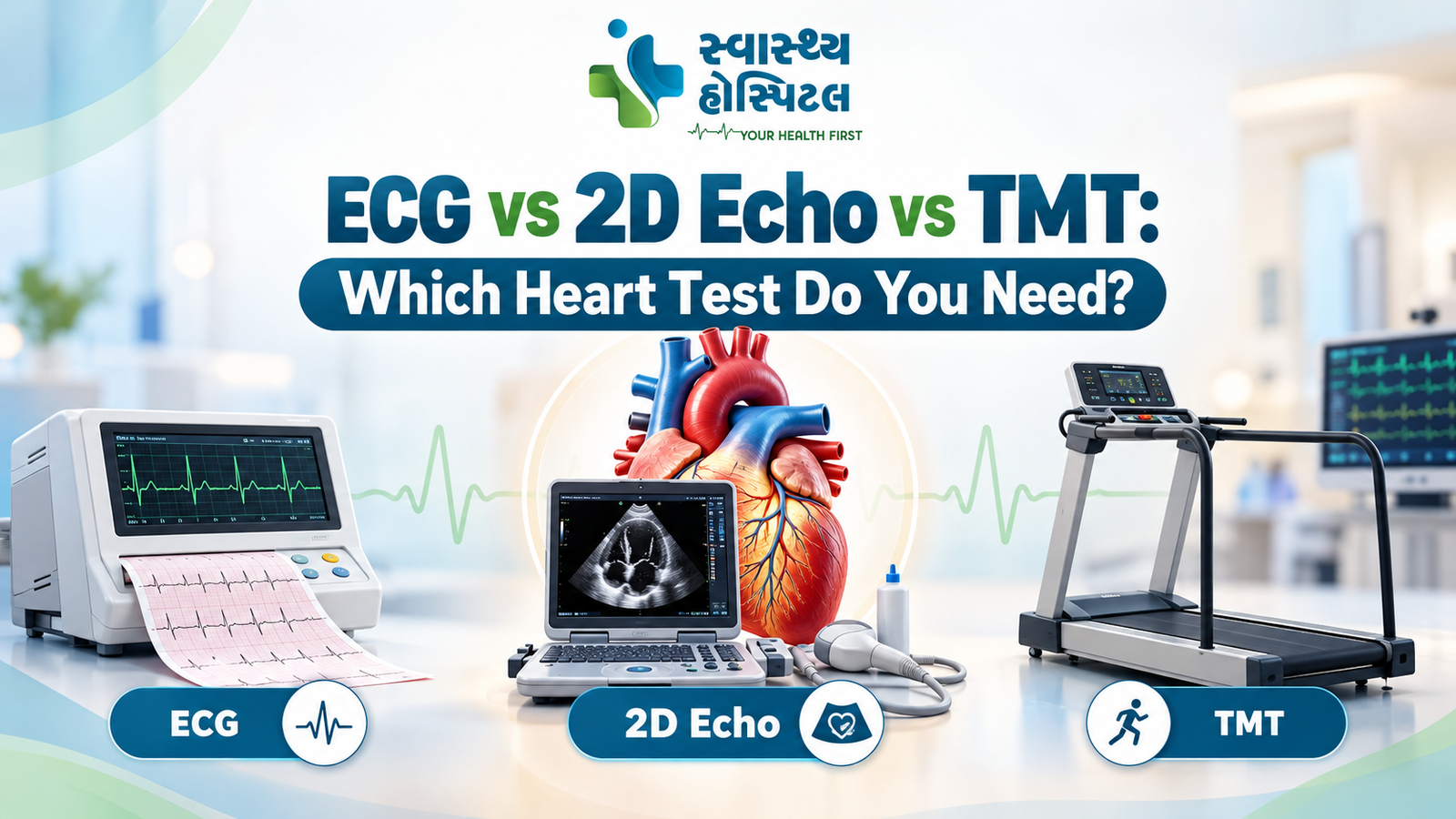
ECG vs 2D Echo vs TMT: Which Heart Test Do You Need?
An ECG records the heart's electrical activity, a 2D echo shows its structure and pumping, and a TMT checks how it copes with exercise. Your doctor chooses by your symptoms.
An ECG records your heart's electrical activity, a 2D echo uses sound waves to show the heart's size, valves and pumping, and a TMT (treadmill test) records an ECG while you exercise to see how your heart copes under stress. Doctors choose according to your symptoms, risk factors and examination, and often more than one test is needed because each answers a different question. Here is what each test shows, what it cannot show, and which symptoms usually lead to which test.
What Does an ECG Show?
An electrocardiogram (ECG) records the electrical activity of your heart, including rate and rhythm. It is used when doctors suspect a heart attack, coronary heart disease or a rhythm problem, and to monitor people with heart conditions (NHS, 2023). You lie still for a few minutes while small sticky pads on your chest, arms and legs pick up the signals.
- Good for: rhythm problems, signs of a heart attack, strain on the heart, and a quick first check.
- Limits: it is a snapshot, so it may look normal between episodes of a rhythm problem or early in a heart attack, and it does not show valves or pumping strength.
- At Swasthya: our facilities include digital ECG machines (see our facilities).
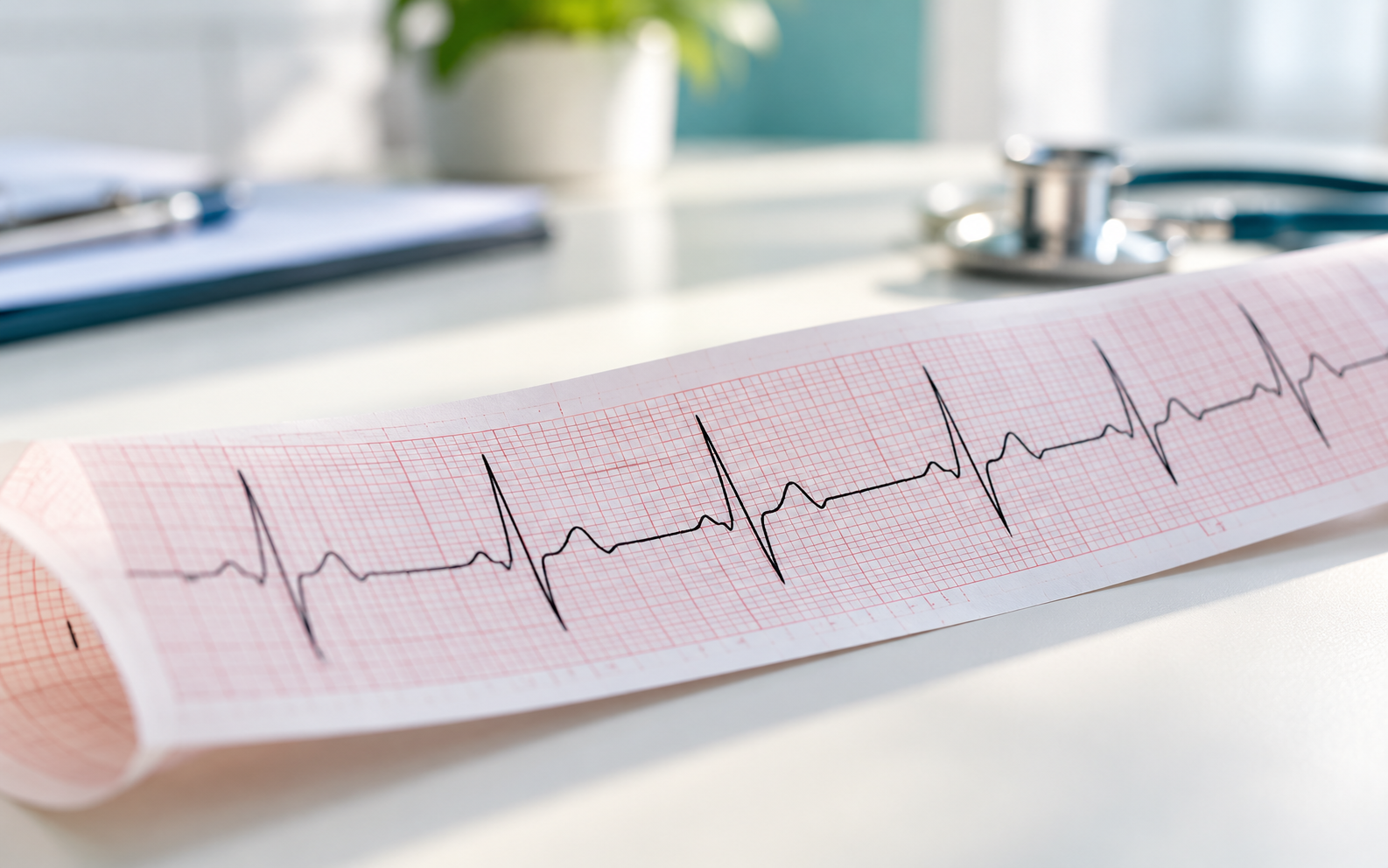
Illustration generated with AI.
What Does a 2D Echo Show?
An echocardiogram uses ultrasound (sound waves) to build a moving picture of your heart, which shows how well it is working. It is used to check for heart failure, valve disease, and the heart's function after a heart attack (NHS, 2026). The common type, a transthoracic echo, is done by moving a probe over your chest and usually takes around 5 to 10 minutes.
- Good for: pumping strength, valve problems, murmurs, enlarged chambers, fluid around the heart.
- Limits: a resting echo may not show a narrowed artery, because blood flow problems often appear only on exertion.
- At Swasthya: we offer 2D echocardiography (see our facilities).
What Does a TMT Show, and Who Needs It?
A TMT, also called a treadmill test, stress test or exercise ECG, records your ECG while you walk on a treadmill with gradually increasing speed and slope. The test is stopped when you develop symptoms or feel too tired. If you cannot exercise, medicine may be given to raise the heart rate (NHS, 2023). Doctors may use it for chest pain that comes on with exertion or to see how your heart responds to effort.
- Good for: how the heart behaves under exertion, and symptoms that appear with activity.
- Limits: not everyone can or should do it. Your cardiologist decides, for example after recent chest pain at rest, uncontrolled blood pressure or severe breathlessness. A normal result does not guarantee that arteries are clear.
- Stress echo is a related test that adds heart scans before and after exercise or after a medicine that mimics exercise (NHS, 2026).
ECG vs Echo vs TMT: How Do They Compare?
| ECG | 2D Echo | TMT (exercise ECG) | |
|---|---|---|---|
| What it records | Electrical activity | Moving ultrasound picture of the heart | ECG during exercise |
| Typical reason | Chest pain, palpitations, a quick check | Breathlessness, swelling, murmur, heart failure, valve disease | Chest pain or breathlessness with exertion |
| Time | A few minutes | About 5 to 10 minutes | Longer: preparation, exercise and recovery |
| Do you exercise? | No | No (not for a resting echo) | Yes (or a medicine that mimics it) |
| What it cannot show well | Valves and pumping strength | Blood flow problems that appear on exertion | Heart structure and valves |
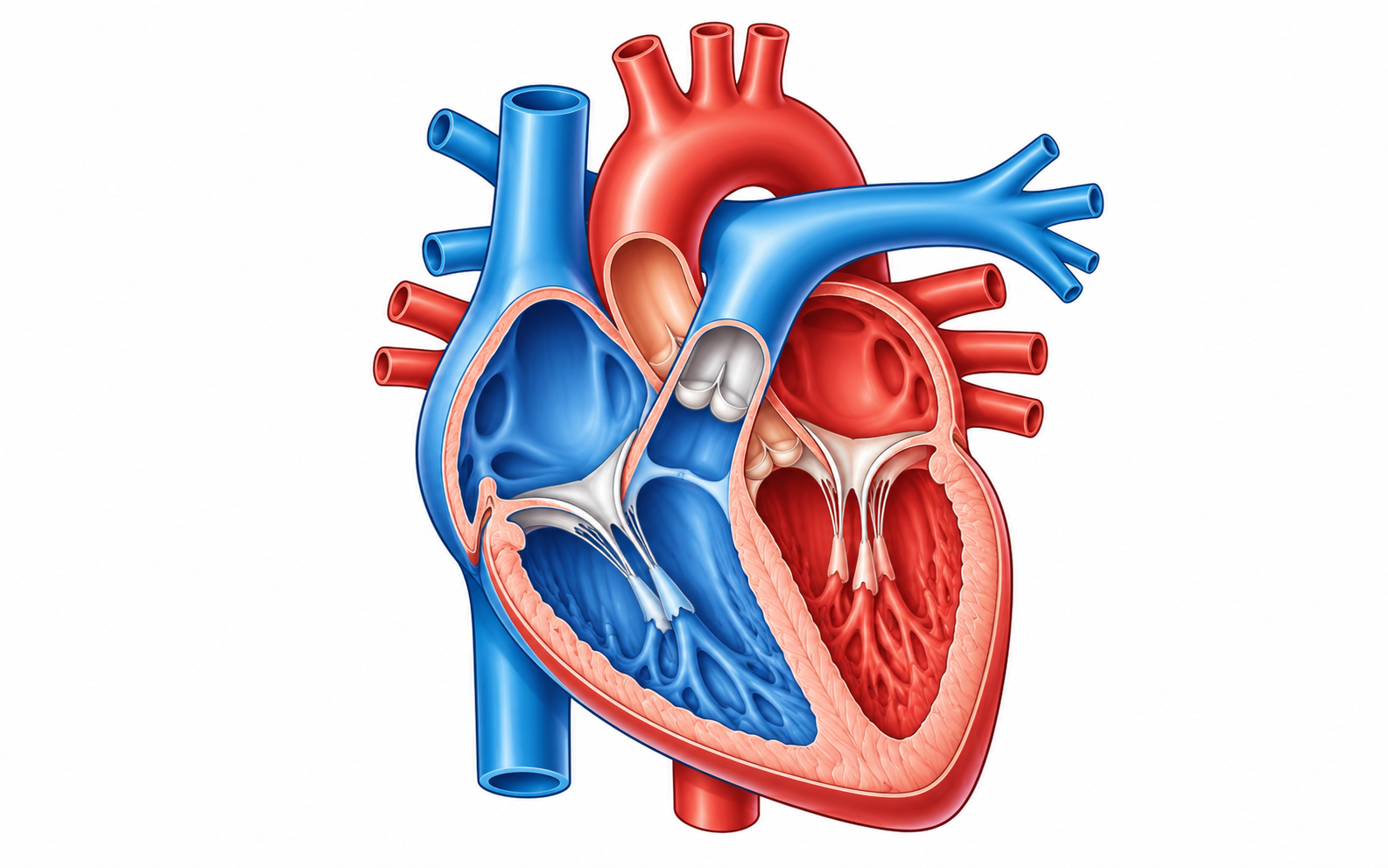
Illustration generated with AI.
Which Heart Test Is Right for Your Symptoms?
This is a general guide. Only your doctor can decide after examining you.
| Your situation | Test often considered first | Why |
|---|---|---|
| Sudden chest pain at rest | ECG (and blood tests) | Quick check for a heart attack; see chest pain and ECG |
| Palpitations or skipped beats | ECG, sometimes a longer recording | Looks for rhythm problems |
| Chest pain or breathlessness when walking or climbing stairs | ECG, then often a stress test (TMT or stress echo) | Shows how the heart responds to effort |
| Breathlessness, leg swelling, or tiredness | 2D echo | Checks pumping strength and fluid |
| A murmur heard by the doctor | 2D echo | Looks at valves and structure |
| Before surgery or a routine check | ECG and 2D echo | Baseline of the heart |
| Family history of heart disease, no symptoms | A doctor's risk assessment first | Tests are chosen by risk, not by habit |
How Should You Prepare for These Tests?
- Bring your previous reports and a list of your medicines.
- Continue your regular medicines unless your doctor tells you otherwise.
- For a TMT, wear comfortable clothes and walking shoes, and follow your doctor's instructions on food and medicines.
- Tell the staff about chest pain, dizziness or breathlessness during any test.
Do You Need Heart Tests If You Feel Fine?
Not as a routine. Heart tests are ordered for a reason: symptoms, a known condition, a risk factor or a pre-procedure check. Having a test "just in case" does not improve your health and can lead to further unnecessary tests, so let your doctor decide based on your symptoms and risk factors. High blood pressure, however, often causes no symptoms, and the WHO estimates that 44% of adults with hypertension do not know they have it (WHO, 2025). Read about high blood pressure in young men.
Frequently Asked Questions
Is an echo or ECG painful?
Neither is normally painful. The ECG pads feel cool and sticky, and the echo probe is pressed gently on your chest with gel.
Does an echo use radiation?
No. Echocardiography uses ultrasound (sound waves), not X-rays.
If my ECG is normal, do I still need an echo?
Possibly. A normal ECG does not show valves or pumping strength. Your doctor decides based on your symptoms.
Can I do a treadmill test if I have knee pain?
Possibly, or an alternative can be used, such as a medicine-based stress test. Tell your doctor about any joint or mobility problems.
Questions About Heart Tests?
Your treating doctor decides which test, if any, is needed. Our cardiology department can answer queries about heart symptoms. The hospital is open 24x7 in Gandhidham.
Contact the HospitalLearn more about our cardiology department.
- NHS. Electrocardiogram (ECG). Page last reviewed 9 November 2023. https://www.nhs.uk/conditions/electrocardiogram/
- NHS. Echocardiogram. Page last reviewed 26 February 2026. https://www.nhs.uk/conditions/echocardiogram/
- Gulati M, Levy PD, Mukherjee D, et al. 2021 AHA/ACC/ASE/CHEST/SAEM/SCCT/SCMR Guideline for the Evaluation and Diagnosis of Chest Pain. Circulation. 2021;144(22):e368-e454. doi:10.1161/CIR.0000000000001029. https://doi.org/10.1161/CIR.0000000000001029
- World Health Organization. Hypertension (fact sheet), 25 September 2025. https://www.who.int/news-room/fact-sheets/detail/hypertension