
Firecracker Smoke and Your Lungs: Why Cough and Wheeze Spike After Diwali
Firecrackers sharply raise fine-particle pollution on Diwali night and for a day or more afterwards. This can trigger cough, wheeze and asthma attacks, especially in people who already have lung or heart disease.
Cough and wheeze rise after Diwali because firecracker smoke fills the air with fine particles and irritant gases that reach deep into the lungs. In a study of Indian cities, fine-particle pollution in Delhi rose by 353% on Diwali day compared with the day before, and the rise in Ahmedabad was about half as large. For most healthy people the effect is short-lived irritation. For people with asthma, COPD or heart disease, smoke can trigger a serious flare. Here is what the smoke does, who is most at risk, and how to protect your lungs.
What Does Firecracker Smoke Do to Your Lungs?
Burning firecrackers releases smoke made up of very fine particles, small enough to travel deep into the airways. The World Health Organization says exposure to fine particulate matter causes cardiovascular and respiratory disease, as well as cancers, and estimates that outdoor air pollution caused 4.2 million premature deaths worldwide in 2019 (WHO, 2024).
In the short term, smoke irritates the lining of the nose, throat and airways, which brings on coughing, a scratchy throat and watery eyes. For people with asthma, smoke, air pollution and cold air are all recognised triggers (NHS, 2025), and Diwali in Kutch brings all three together on cooler November nights.
How Much Does Air Pollution Rise During Diwali?
A 2022 study measured festival pollution in several Indian cities. On Diwali day, fine particles (PM2.5) in Delhi rose by 353% compared with the day before Diwali, and the increase in Pune and Ahmedabad was about 50% of Delhi's. The researchers also found that the amount of pollution people breathed in stayed considerably high after Diwali in Delhi and Ahmedabad (Latha et al., 2022).
Ahmedabad is the closest of the studied cities to Kutch. We are not aware of a similar study for Gandhidham, and levels in any neighbourhood depend on the wind and on how many firecrackers are burst nearby. The pattern is what matters: the smoke peaks on Diwali night and can linger into the next day.
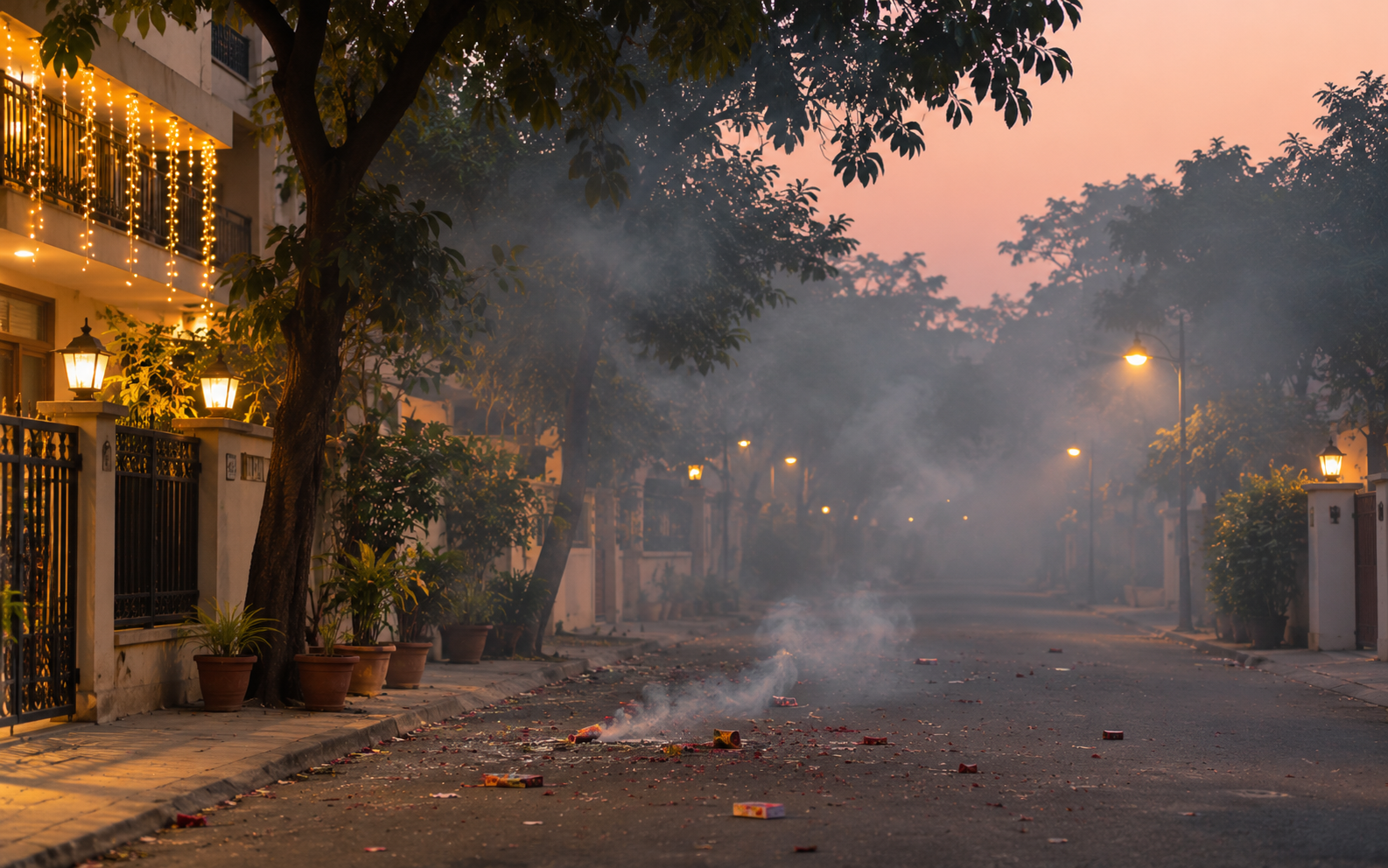
Illustration generated with AI.
Who Is Most at Risk From Diwali Smoke?
- People with asthma or COPD: smoke and pollution are common triggers for flares (NHS, 2025)
- People with heart disease: fine particles are linked to cardiovascular disease as well as lung disease (WHO, 2024)
- Young children and older adults, who are usually advised to take extra care
- People with allergic rhinitis, whose noses are already sensitive to irritants
- Anyone bursting crackers at close range, especially in narrow lanes or enclosed courtyards
How Can You Protect Your Lungs During and After Diwali?
- Stay indoors when the smoke is heaviest, usually Diwali night and the next morning, and keep windows closed during those hours.
- Keep your distance. Stand well back from crackers being burst, and away from the drift of the smoke.
- If you have asthma, keep your reliever inhaler with you, keep taking your regular preventer, and follow your asthma action plan.
- Avoid outdoor exercise, such as morning walks, while the air is still smoky.
- Do not burst crackers indoors or close to someone with asthma, a baby or an older person.
A Note on Masks
Cloth masks, paper masks and handkerchiefs do not filter smoke. A respirator marked N95 can, but only if it fits snugly with no air leaking at the sides; beards stop a proper fit, and these respirators are not designed to fit children. US air-quality guidance also advises using a respirator only after first trying other steps, such as staying indoors (AirNow, 2020). People with heart or lung disease should ask their doctor before relying on one.
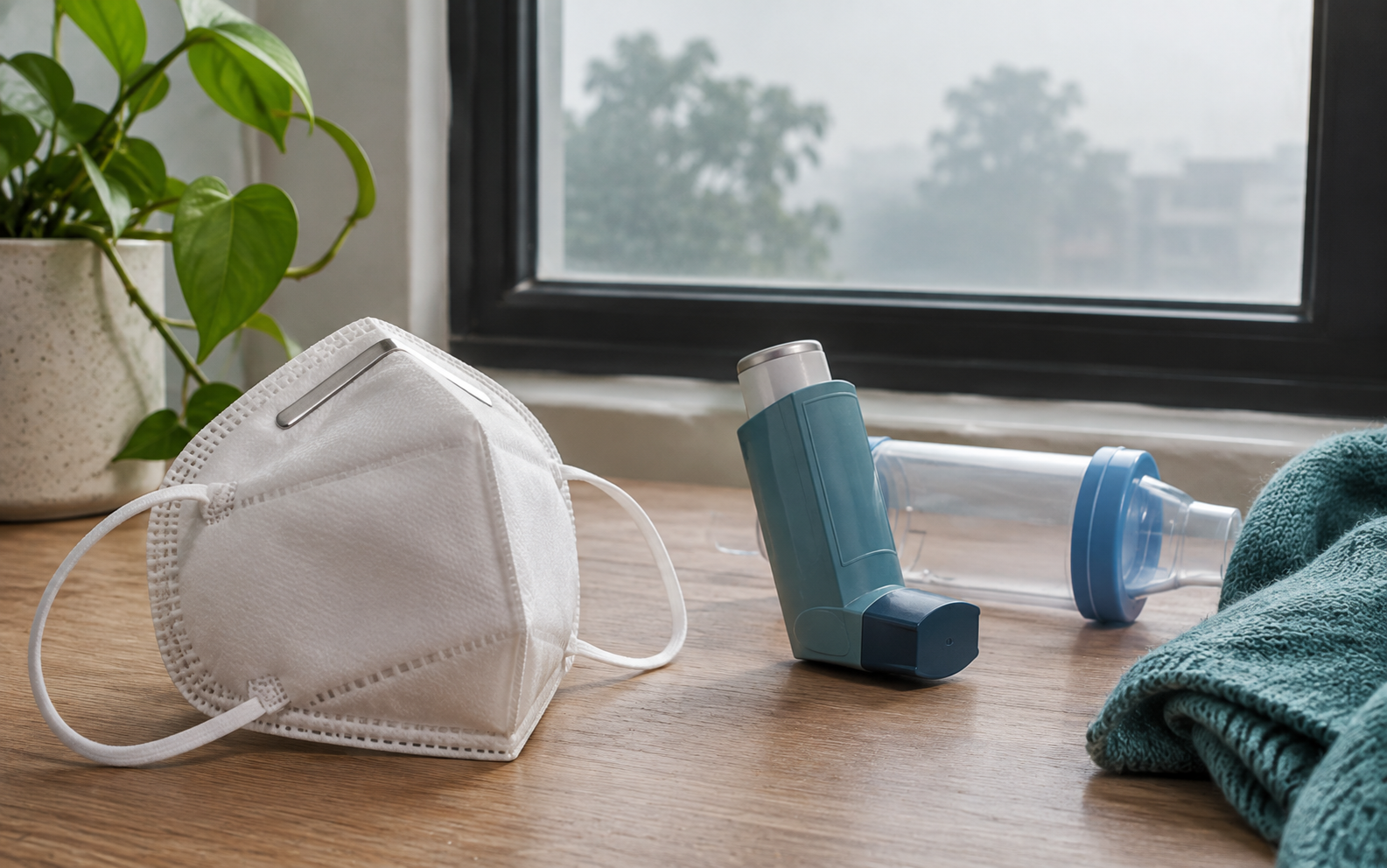
Illustration generated with AI.
How Can You Protect Children and Older Relatives on Diwali Night?
- Keep babies and young children indoors during the heaviest bursting, away from doors and windows that open onto the street.
- Keep an older relative's regular medicines and any inhaler within reach, and check on them through the evening.
- If a child with asthma starts coughing or wheezing at night, follow their asthma action plan and watch for the warning signs below.
- The next morning, clear firecracker debris with water and a mop rather than dry sweeping, so the dust and residue are not thrown back into the air.
Respirator masks are not designed to fit children (AirNow, 2020), so for children the main protection is staying indoors with windows closed while the smoke is heavy.
When Is a Cough After Diwali More Than Irritation?
Signs of an asthma attack and what to do
An asthma attack means severe symptoms and difficulty breathing, with wheezing, coughing, breathlessness or a tight chest. Sit up straight and try to stay calm. With a blue reliever inhaler, NHS guidance is to take 1 puff every 30 to 60 seconds, up to a maximum of 10 puffs, unless your own asthma action plan says otherwise (NHS, 2025).
Call emergency services (108 or 112) if the person feels worse at any time, does not improve after the maximum puffs, or has no inhaler. Do not drive yourself to hospital.
See a doctor if a cough lasts more than three weeks, if you develop fever with breathlessness, or if you start wheezing for the first time after smoke exposure.
Frequently Asked Questions
Is a surgical or cloth mask enough to block firecracker smoke?
No. Cloth and paper masks do not filter smoke. A well-fitted N95 respirator can reduce the fine particles you breathe in, but staying indoors when the smoke is heaviest comes first.
How long does Diwali smoke stay in the air?
It peaks on Diwali night, and in the 2022 study the amount people breathed in stayed high the day after Diwali in Delhi and Ahmedabad. Wind and weather decide how quickly it clears where you live.
I don't have asthma. Should I still worry?
Most healthy people get short-lived irritation: cough, sore throat and watery eyes. Wheezing, chest tightness or breathlessness are not normal and should be checked.
Should I change my asthma medicines before Diwali?
Do not change or stop any medicine on your own. Ask your doctor in advance whether your asthma action plan needs adjusting for the festival.
Breathing Trouble After Diwali?
For an asthma attack or severe breathlessness, call 108 or 112. For a cough or wheeze that is not settling, contact the hospital; it is open 24x7 in Gandhidham.
Contact the HospitalRelated reading: lung and allergy care, early morning sneezing in Gandhidham, fever red flags.
- World Health Organization. Ambient (outdoor) air quality and health (fact sheet), 24 October 2024. https://www.who.int/news-room/fact-sheets/detail/ambient-(outdoor)-air-quality-and-health
- Latha R, Anand V, Korhale N, Kori P, Murthy BS. Festival ushered pollutants in Indian metropolitan cities: resemblance, variance, and concerns. Environmental Processes. 2022;9(3):42. doi:10.1007/s40710-022-00593-9 https://doi.org/10.1007/s40710-022-00593-9
- NHS. Asthma: causes. Page last reviewed 7 April 2025. https://www.nhs.uk/conditions/asthma/causes/
- NHS. Asthma attacks. Page last reviewed 7 April 2025. https://www.nhs.uk/conditions/asthma/asthma-attack/
- AirNow (US Environmental Protection Agency). Protect your lungs from wildfire smoke or ash: the right respirator and proper fit (fact sheet), 2020. https://www.airnow.gov/sites/default/files/2020-02/the-right-respirator-and%20proper-fit-508.pdf